 English

Views: 0 Author: Site Editor Publish Time: 2026-09-07 Origin: Site


What is a 6x4 tractor truck, and why is this axle layout common in heavy-duty transport? In simple terms, a 6×4 tractor truck normally uses three axles: a steering front axle and two rear drive axles. The tandem rear axles transfer engine torque to the road and help the vehicle manage demanding traction conditions when operating as part of a tractor–semi-trailer combination.
The layout can be a strong fit for regional haulage, construction logistics, difficult roads, and other applications that require more driven-axle traction than a typical 4×2 configuration. It is not automatically the best choice for every fleet, however. Buyers should compare route conditions, operating weight, maneuvering requirements, regulations, maintenance resources, and trailer interfaces before selecting a 6x4 truck tractor.
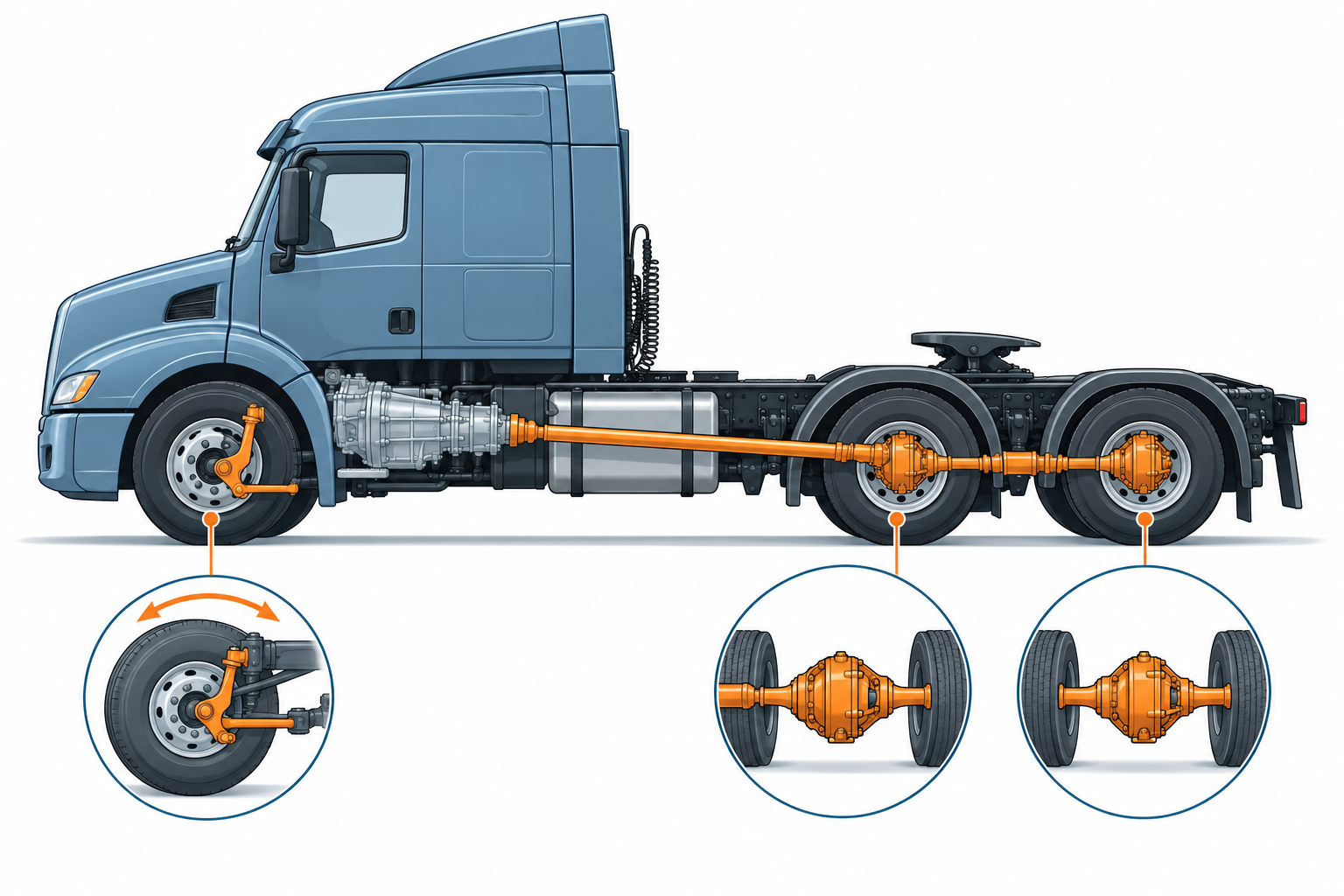
In common commercial-vehicle terminology, 6×4 describes a tractor truck with three axles and four driven wheel ends. On a conventional 6×4 semi-truck tractor:
the front axle is primarily used for steering;
the two rear axles are drive axles;
the driveline distributes torque through the rear axle group;
the tandem arrangement supports traction and load management across the rear of the chassis;
the configuration is generally intended for heavier or more demanding work than a basic 4×2 layout.
The numbers describe the drive arrangement, not the truck's complete performance. A 6×4 designation does not by itself tell you the engine output, transmission, axle ratings, emissions level, wheelbase, fifth-wheel position, or legal operating limits. Those details must be confirmed in the exact vehicle specification.
The front axle supports the front section of the cab and provides directional control. Its steering geometry affects turning behavior, tire wear, and the way the truck responds when connected to a trailer. The axle rating and tire specification must match the approved vehicle configuration and the legal requirements of the operating market.
The two rear axles receive torque from the engine and transmission through the driveline. Their differentials and axle components allow the rear wheels to rotate at appropriate speeds while the truck moves through turns or changes in road surface.
The tandem group also spreads the supported load across two rear axles instead of concentrating all drive-axle responsibility on one axle. The result is a configuration designed to provide useful traction and load distribution for demanding transport work. Actual performance still depends on axle ratings, tires, suspension, road surface, trailer setup, and the complete combination weight.
The engine creates torque, the transmission selects a usable speed and torque range, and the driveline transfers that output to the rear drive axles. A 6×4 system therefore needs to be evaluated as a complete powertrain rather than as an isolated axle choice.
When comparing a truck tractor 6x4 configuration, ask for the engine, transmission, rear-axle, suspension, and tire information together. This helps prevent a common sourcing mistake: selecting the drive layout first and checking the operating application only after the vehicle has already been quoted.
The most direct benefit of a 6×4 layout is that two rear axles contribute to propulsion. This can help the tractor truck maintain useful traction when roads are wet, uneven, loose, inclined, or affected by changing surface conditions.
Traction is not guaranteed by the axle label alone. Tire tread, tire pressure, axle loading, differential design, suspension behavior, and driver control all influence how the truck performs. Even so, two driven rear axles give the vehicle a broader traction base than a single-drive-axle configuration.
A tractor truck works as part of a complete combination. When the application involves a heavy semi-trailer, frequent starts, irregular surfaces, or changing gradients, the rear-drive arrangement can provide a practical balance between propulsion and chassis support.
This does not mean that every 6×4 can operate at every legal or technical limit. Buyers must still confirm the axle ratings, suspension, fifth-wheel position, trailer connection, and market regulations for the intended combination.
Many fleets do not operate on one perfectly uniform route. A vehicle may alternate between highways, industrial access roads, construction sites, ports, regional distribution points, and less predictable surfaces. A 6x4 tractor truck can offer more flexibility for this mixed operating environment than a layout designed mainly for light or steady highway work.
The trade-off is that additional driven components can add mechanical complexity, vehicle weight, and maintenance requirements. The buyer should therefore consider the actual route rather than choosing the most heavily configured truck by default.
A 6×4 layout may help the driver maintain forward movement when one driven axle experiences a less favorable contact condition. It is especially relevant when the route includes loading yards, uneven access roads, temporary worksites, or weather-related surface changes.
This is an application advantage, not a substitute for correct speed, braking practice, tire selection, or route planning. The configuration supports the vehicle's operating capability, while safe operation still depends on the complete vehicle and working procedure.
The right application is defined by the combination of route, trailer, operating cycle, terrain, and local requirements. Typical cases where a 6×4 may deserve consideration include:
Regional or long-distance operations may involve different road surfaces, loading yards, weather conditions, and elevation changes. A 6×4 can be considered when the fleet needs more traction flexibility than a 4×2 while still using a conventional highway tractor format.
Construction-related transport often includes temporary roads, uneven access points, worksite entrances, and changing surface conditions. A 6×4 may be useful when the tractor must travel between paved roads and industrial or construction areas.
Ports, factories, quarries, and distribution facilities can create frequent start-stop work, ramp access, and mixed pavement conditions. The axle layout should be assessed together with the trailer connection, turning space, tire selection, and expected operating cycle.
For a 6x4 semi truck tractor for export, buyers should describe the actual destination conditions instead of assuming that a configuration suitable in one country will be suitable in another. Climate, fuel, road quality, service resources, emissions rules, vehicle dimensions, and registration requirements can all affect the final choice.
The choice between 6×4 and 4×2 should follow the operating requirement, not a general belief that one layout is always superior.
| Comparison point | 6×4 tractor truck | 4×2 tractor truck |
|---|---|---|
| Driven axles | Two rear drive axles | One rear drive axle |
| Traction focus | Better suited to applications that regularly need additional driven-axle traction | Often suitable for steady paved-road work where one drive axle is adequate |
| Mechanical system | More driven components and a more complex rear axle group | Simpler driveline arrangement |
| Vehicle trade-offs | May involve additional weight, rolling resistance, and maintenance considerations | May offer a lighter and simpler configuration, depending on the model |
| Typical selection question | Will the route, combination, and surface conditions justify two driven axles? | Can the vehicle meet the route requirements with one driven axle? |
This comparison is a starting point rather than a complete vehicle recommendation. Engine output, transmission ratios, suspension, tires, axle ratings, wheelbase, cab design, and trailer interface can change the practical result.
A 6×4 tractor truck does not work independently from its semi-trailer. The buyer should confirm the main connection and clearance interfaces before finalizing the configuration. These include the fifth-wheel specification and position, kingpin relationship, chassis dimensions, electrical and air connections, tire clearance, turning envelope, and the trailer's intended operating conditions.
The goal is not to assume that a 6×4 can be paired with every trailer. The goal is to verify that the proposed tractor and trailer form a workable combination under the intended route and legal requirements.
Ask the supplier to state which assumptions were used in the proposal. If the buyer will use more than one trailer type, provide the relevant dimensions and connection requirements for each use case. The final specification should identify the approved configuration rather than leaving compatibility to post-delivery adjustment.
A real product page can make the configuration easier to understand. The CAMC H9 6×4 diesel tractor truck page lists a diesel powertrain, a 6×4 drive form, and 430 hp output. These details show how a product should be described at the initial comparison stage: the buyer can see the fuel type, drive layout, and stated engine output before requesting application-specific confirmation.
The H9 example should not be treated as a universal answer for every route or trailer. The buyer should still confirm the exact engine and emissions configuration, axle ratings, transmission, dimensions, fuel tank, cab options, trailer interfaces, and market documentation for the intended order.
For buyers comparing several vehicle types, the CAMC tractor truck range provides a category-level starting point. Narrow the selection only after the route, combination, terrain, and regulatory requirements have been defined.
Before comparing a 6x4 tractor truck for sale or requesting a wholesale quotation, prepare a short application brief and ask the supplier to respond against the same points.
| Requirement | What to confirm |
|---|---|
| Operating route | Highway, regional, construction, port, industrial, or mixed use |
| Surface and terrain | Paved, uneven, loose, wet, inclined, or seasonal conditions |
| Combination | Intended semi-trailer type, connection requirements, and clearance limits |
| Drive layout | Confirmation that the proposed vehicle is a 6×4 with two rear drive axles |
| Powertrain | Engine output, displacement, fuel type, transmission, and available options |
| Axle and suspension | Front and rear axle ratings, suspension type, tires, and approved configuration |
| Dimensions | Overall length, width, height, wheelbase, turning, and loading constraints |
| Market requirements | Emissions, registration, safety, import, and documentation requirements |
| Maintenance | Parts identification, service materials, maintenance intervals, and support contacts |
| Order documents | Specification, quotation, option list, inspection record, and shipping documents |
The supplier's answer should distinguish published base specifications from optional equipment and market-specific adaptations. A qualified 6x4 tractor truck manufacturer or export supplier should also identify which points require final confirmation before production or shipment.
"6×4" indicates a drive arrangement, not a complete operating solution. A buyer who provides no route, trailer, terrain, or duty-cycle information makes it difficult for any supplier to recommend the right specification.
Two driven rear axles can support traction, but performance also depends on tires, axle loading, surface conditions, driveline design, suspension, and driver behavior. Avoid presenting the layout as a guarantee of performance or safety.
A 6×4 may be the right technical choice, but the buyer should consider its full operating effect, including purchase price, fuel use, tire wear, maintenance, spare parts, and vehicle weight. The relevant question is whether the additional capability is used often enough to justify the trade-off.
Different versions of one model may use different powertrains, axle ratings, emissions levels, cab options, or equipment packages. Request the configuration that will actually be produced and shipped.
The tractor, fifth wheel, trailer, and route should be checked as one system. Resolve connection, clearance, and operating assumptions before the order is finalized.
A 6x4 tractor truck normally combines a steering front axle with two rear drive axles. This layout can provide a useful balance of traction and load distribution for demanding regional, industrial, construction, and mixed-route transport applications. It also brings additional components and operating considerations that should be included in the selection decision.
The best choice depends on the complete application: route, surface, trailer, powertrain, axle ratings, dimensions, regulations, maintenance resources, and export documentation. Use the 6×4 designation as the starting point for a technical conversation, then confirm the exact vehicle configuration before comparing prices or placing an order.
A 6x4 truck tractor normally has three axles: one steering front axle and two rear drive axles. The "6×4" designation describes the common wheel-end and driven-wheel arrangement. It does not define the engine, transmission, axle ratings, emissions level, or legal operating limit.
Neither layout is always better. A 6×4 may suit routes that regularly require more driven-axle traction, while a 4×2 may be suitable for steady paved-road work where one drive axle is adequate. Compare the complete operating cycle and total operating cost.
It may be suitable when the destination fleet operates on mixed, uneven, inclined, industrial, construction, or changing road surfaces. The buyer must still confirm local regulations, emissions requirements, fuel conditions, trailer interfaces, service resources, and documentation.
No. Compatibility depends on the fifth wheel, kingpin, chassis dimensions, clearances, electrical and air connections, turning envelope, trailer design, and legal requirements. Confirm the tractor–trailer combination before ordering.
No. In common usage, a 6×4 tractor truck has four driven wheel ends across the two rear drive axles. The front axle is normally the steering axle rather than a driven axle.


