 English

Views: 0 Author: Site Editor Publish Time: 2026-07-06 Origin: Site


Fleet operators face immense pressure to decarbonize heavy-duty hauling cycles. Moving past glossy green public relations requires analyzing raw operational data closely. Transitioning from diesel to electric introduces complex new variables. Managers must account for severe battery weight penalties, extended charging downtime, and strict site infrastructure limits. Electric heavy hauling simply operates differently.
We provide procurement and fleet managers an actionable, decision-stage framework. You will learn to evaluate technical specifications accurately. We help you calculate economic feasibility and shortlist capable vehicles. Proper planning prevents expensive operational bottlenecks later.
Your final procurement choices must meet rigorous site demands entirely. Analyzing axle configurations and continuous motor outputs reveals true capability. This ensures high daily productivity remains intact. By following these guidelines, you integrate electric hauling smoothly.
Payload Realities: Heavy EV batteries eat into Gross Vehicle Weight (GVW); comparing the chassis-to-payload ratio is critical for maintaining profitable haul cycles.
Axle Configuration: The 8X4 setup provides the necessary weight distribution and traction to compensate for battery density compared to standard 6X4 EV configurations.
Infrastructure is the Product: Evaluating an EV tipper truck requires parallel evaluation of DC fast-charging or battery-swapping capabilities suited to your specific route loops.
TCO Breakeven: Higher upfront Capex is offset by regenerative braking efficiency, reduced fluid maintenance, and stable electricity costs, but only if the truck achieves high daily utilization.
Electric vehicle batteries add massive tare weight instantly. A traditional 6X4 configuration often struggles under these conditions. It cannot meet legal axle load limits when carrying heavy bulk materials. The 8X4 dump truck offers a distinct mechanical advantage here. Twin-steer front axles distribute the extreme weight safely. They handle large kilowatt-hour battery packs easily.
This setup maintains proper steering geometry over rough terrain. It also extends tire longevity significantly. You gain superior traction and gradeability immediately. Off-road, muddy, or unpaved mining sites demand these specific capabilities. A standard 6X4 often loses grip in these exact same environments.
Best Practice: Always evaluate tire ply ratings alongside your axle configuration. Twin-steer axles require robust commercial tires to handle heavy cornering forces.
Regional highway laws enforce strict bridge and weight regulations globally. The 8X4 setup helps fleets maximize legal payload capacities fully. You avoid costly compliance fines entirely. Weight spreads evenly across four independent axles. This prevents rapid structural fatigue in the main chassis frame. Proper weight distribution keeps haul cycles highly profitable.
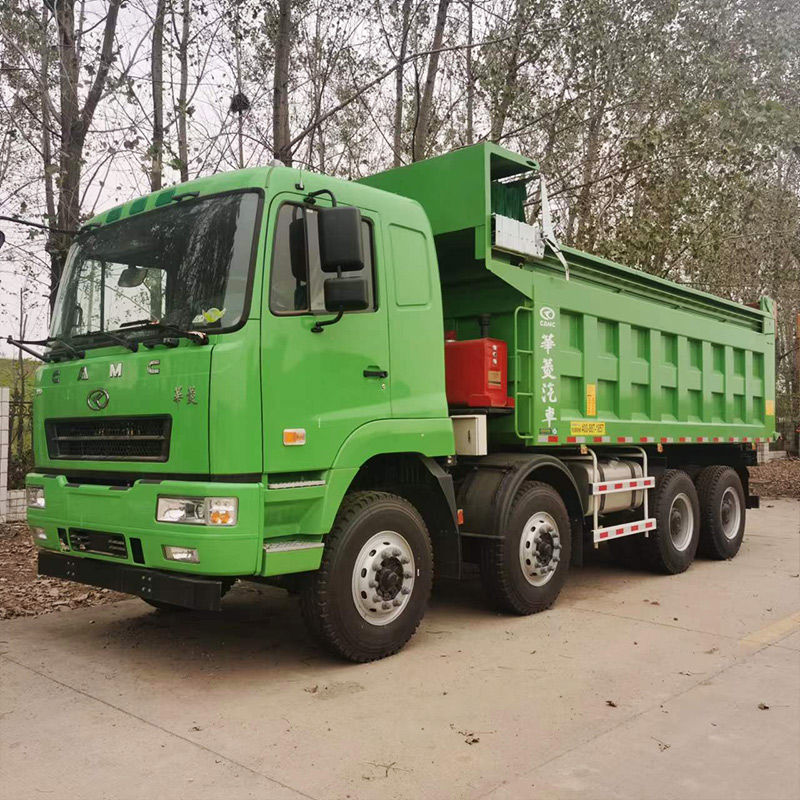
Evaluate battery capacity against total vehicle weight carefully. Larger batteries provide substantially more driving range. However, they directly reduce the revenue-generating payload of the tipper truck. A massive battery pack might weigh over three tons. You lose exactly three tons of billable payload capacity.
You must find the "Goldilocks" capacity metric. This capacity perfectly matches your specific route loop length. Do not buy extra range you never actually use.
Look closely at continuous torque rather than peak horsepower. Continuous torque matters most for heavily loaded uphill starts. Peak power only lasts for very short bursts. Heavy hauling requires sustained power output continuously.
Single-motor central drives differ from dual-motor e-axle designs. Central motors utilize standard driveshafts reliably. E-axles improve overall drivetrain efficiency dramatically. They remove heavy mechanical linkages completely. However, e-axles complicate field maintenance slightly for traditional mechanics.
Active thermal management is completely non-negotiable for heavy hauling. Liquid cooling and heating protect internal battery cells consistently. These systems prevent severe thermal throttling on long inclines.
Extreme weather degrades battery performance quickly. Cold climates slash operational range significantly. Liquid heating warms the pack before the shift begins. Common Mistake: Relying on simple air-cooled battery systems in high-temperature mining sites always leads to frequent vehicle shutdowns.
Regenerative braking captures kinetic energy effectively on downhill runs. This provides a major operational advantage instantly. Mining fleets rely on this energy recovery daily.
Descending a steep grade recharges the battery passively. The electric motor acts as a heavy generator. This saves friction brakes from overheating entirely. Fleet operators report massive savings on replacement brake pads.
Technical Evaluation Chart
| Specification Category | Standard Metric | Heavy-Duty Fleet Requirement |
|---|---|---|
| Battery Pack Size | 200 - 300 kWh | 350 - 450 kWh (Depending on payload laws) |
| Continuous Torque | 1,500 Nm | 2,500+ Nm for steep grade climbing |
| Thermal Management | Air Cooled | Active Liquid Cooling and Heating |
| Charging Speed | 150 kW DC | 300+ kW DC or Battery Swapping |
Evaluating a 8X4 EV dump truck requires a parallel infrastructure strategy. You cannot separate the truck from its power source. Fleets must solve uptime challenges before taking vehicle delivery.
DC Fast Charging (Megawatt Systems): This strategy suits shift-based work perfectly. Trucks charge overnight at the depot. Drivers can also plug in during mandated break periods. High-capacity megawatt chargers push energy rapidly.
Battery Swapping Technology: This serves continuous 24/7 closed-loop operations better. Ports and open-pit mines adopt this standard rapidly. Three-minute automated swap times eliminate charging downtime entirely. You keep the fleet moving continuously.
Mobile Power Stations: Remote sites deploy battery-buffered mobile chargers. These units store solar power locally. They dispense energy without requiring massive grid upgrades.
Assess grid capacity at your depot immediately. Do this before signing any procurement contract. Local utilities often require several months to upgrade site power. Grid delays routinely paralyze new electric fleet deployments.
Acknowledge the high initial purchase price upfront honestly. Electric heavy trucks require significant initial capital. You must factor in available government grants aggressively. Tax incentives and carbon credits offset this initial capital expenditure.
Operational expense reductions accumulate quickly over time. You eliminate volatile diesel costs entirely. You remove expensive diesel exhaust fluid from your budget. Furthermore, you eliminate costly internal combustion engine maintenance schedules. Oil changes, transmission rebuilds, and DPF filter replacements disappear forever.
Regenerative braking extends friction brake life by up to 50 percent. This massive reduction in wear lowers parts and labor expenses. Mechanics spend far less time performing routine brake jobs.
To find a realistic economic breakeven point, input specific assumptions. Model local electricity rates against long-term diesel price projections. Calculate intended lifecycle years carefully. High daily vehicle utilization always drives economic success faster. Parked electric trucks do not generate ROI.
Some operational environments guarantee high success rates. Others pose severe financial risks. You must evaluate topography and route predictability objectively.
High Success Environments:
Fixed-route operations provide highly predictable daily energy consumption.
Quarries, cement plants, and urban excavation sites fit electric hauling perfectly.
Routes featuring loaded downhill segments maximize regenerative braking yields massively.
Urban zones enforcing strict noise and tailpipe emission regulations require electric fleets.
High Risk Environments:
Long-haul, unpredictable routes pose severe logistical challenges.
Varied terrain draining battery life unpredictably creates driver range anxiety.
Zero guaranteed public charging access halts hauling operations completely.
Extremely remote sites lack reliable grid infrastructure entirely. Only deploy here if you utilize robust micro-grid solutions.
Follow a strict shortlisting logic always. Run a localized pilot program first. Test one or two units thoroughly in actual site conditions. Gather empirical payload and battery performance data. Do this before committing to a full fleet transition.
An electric heavy truck is never a simple drop-in replacement for diesel. It represents a fundamental, systemic shift in how fleets operate daily. You must adapt dispatching, maintenance, and facility infrastructure entirely.
Map your exact daily mileage immediately. Calculate strict payload needs and analyze route topography carefully. Demand that manufacturers provide simulated performance data based on those specific parameters. Never rely on generic marketing brochures.
Take decisive action today. Contact a specialized fleet electrification consultant immediately. Request a comprehensive route analysis from your chosen manufacturer. Download a facility grid evaluation checklist to begin infrastructure planning.
A: You typically lose one to two tons of payload capacity. Heavy lithium-ion battery packs create a direct weight penalty. The exact loss depends entirely on battery size and local axle weight regulations. Fleets often compensate by optimizing route frequencies and turnaround times.
A: Charging times vary based on the charger's kilowatt capacity. High-power DC fast chargers refill a heavy truck in 1.5 to 3 hours. Alternatively, automated battery swapping stations replace depleted packs in roughly three to five minutes.
A: They perform reliably only if equipped properly. Cold temperatures restrict battery chemical reactions directly. You must specify active liquid thermal management systems. These systems heat the battery pack automatically, preventing severe range loss and maintaining power delivery during freezing shifts.
A: Commercial battery packs endure thousands of deep charge cycles. Manufacturers typically provide warranties spanning five to eight years. Capacity degrades slowly over time. Most packs retain roughly 80 percent of their original capacity after five years of intense daily hauling.


