 English


Views: 0 Author: Site Editor Publish Time: 2026-11-18 Origin: Site


Committing capital to a new fleet asset is a high-stakes operational decision for any logistics business. Choosing the wrong vehicle layout leads to inflated fleet expenses, sub-optimal payload utilization, and severe routing inefficiencies. These missteps quickly erode profit margins in highly competitive transportation markets. Fleet managers frequently face a difficult trade-off during procurement cycles. They must balance the modular payload capacity of articulated combinations against the urban accessibility of single-unit vehicles. Making the right choice requires deep operational foresight and accurate data.
This guide breaks down the operational, financial, and structural differences between rigid setups and tractor units. We provide an evidence-based framework to align your procurement decision with your actual delivery constraints. You will learn exactly how to match payload scalability, route compliance, and maintenance realities to your unique logistics model.
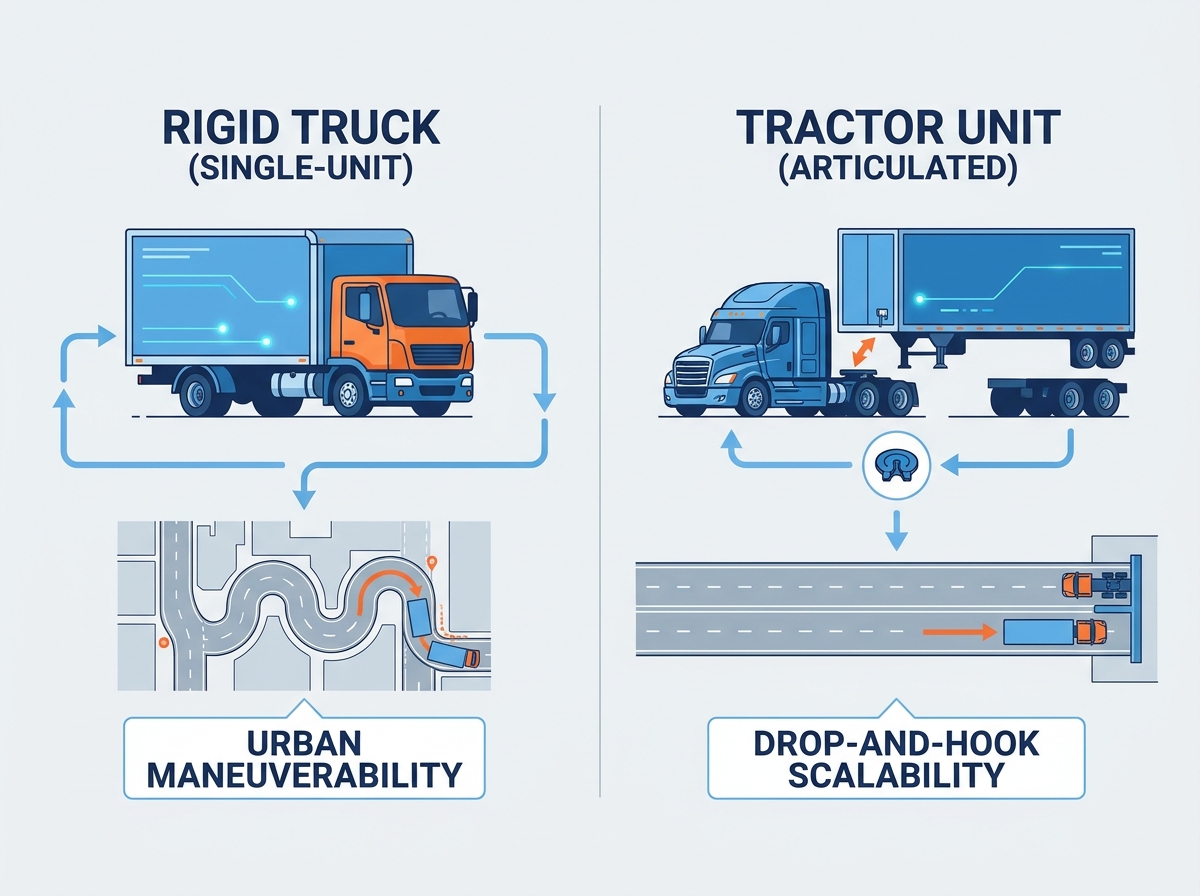
Modularity vs. Simplicity: Tractor units enable "drop-and-hook" operational scalability, whereas rigid setups provide a fixed, unified platform for consistent regional routes.
Route Constraints: Single-unit rigid trucks inherently excel in urban multi-drop environments due to shorter turning radii and fewer municipal weight/size restrictions.
Cost Dynamics: While a tractor truck requires higher upfront capital and more complex maintenance schedules, its secondary market liquidity and maximum Gross Combination Weight (GCW) often yield a better ROI for long-haul linehaul operations.
Understanding the baseline engineering of your fleet assets is the first step in effective procurement. The physical architecture of a commercial vehicle dictates its legal payload limits, routing capabilities, and daily workflow.
A single-unit configuration integrates the cab, chassis, and cargo body permanently onto one continuous frame. In this setup, the rigid cargo truck operates strictly as a fixed asset. The payload space cannot be detached from the powertrain. When the vehicle goes into the shop for engine maintenance, the cargo box remains out of service alongside it.
This design reality creates a highly unified, predictable vehicle platform. Drivers handle a single vehicle body without worrying about articulation points. Fleet operators rely on these vehicles for localized distribution. They excel where payload volumes remain relatively stable week over week.
In contrast, the tractor truck is an articulated towing vehicle designed exclusively to pull semi-trailers. It does not carry freight directly on its own chassis. Instead, it provides the motive power to pull massive, detachable loads over long distances.
The tractor truck structure is built around a heavy-duty chassis, a specialized cab configuration, and a critical fifth-wheel coupling system. This fifth wheel connects to the trailer's kingpin. The powertrain and the cargo-carrying trailer function as completely separate, interchangeable assets. You can pair one towing unit with a dry van on Monday and a flatbed on Tuesday. This structural separation forms the backbone of modern linehaul logistics.
Modern fleets face a constant business problem. You must scale delivery volumes without over-investing in unused cargo space. At the same time, you must prevent costly empty miles. How you handle payload scalability determines your overall profitability.
Combination vehicles offer unmatched operational flexibility. They support exceptionally high Gross Combination Weights (GCW). This allows operators to move massive amounts of freight in a single trip. The core advantage, however, lies in asset decoupling.
Because the trailer is separate, drivers execute "drop-and-hook" workflows. A driver arrives at a distribution center, drops an empty trailer at the dock, and immediately hooks up to a pre-loaded trailer. This process takes minutes. It eliminates driver idle time. You keep your most expensive assets—the engine and the driver—moving constantly. The warehouse team can take hours to load a dropped trailer without holding up your transport schedule.
Single-unit vehicles face strict payload ceilings. These limits depend entirely on the fixed chassis length and the specific axle weight rating. You cannot simply attach a larger cargo box if client demand spikes.
Furthermore, these vehicles enforce a coupled workflow. The driver and the engine must remain idle while the vehicle is actively being loaded or unloaded at a facility. If a dock delay occurs, your driver loses valuable service hours. The ideal use case for this format involves consistent, predictable payload volumes. It works best when cube-out (volume limits) and weigh-out (weight limits) metrics rarely fluctuate.
Payload Scalability Comparison
| Operational Metric | Single-Unit Architecture | Combination Architecture |
|---|---|---|
| Payload Flexibility | Fixed to chassis size. Cannot be expanded. | Highly flexible. Swap trailers based on freight type. |
| Loading Efficiency | Driver waits during loading/unloading. | Drop-and-hook capability minimizes wait times. |
| Gross Weight Limits | Restricted by single-frame axle capacity. | High Gross Combination Weight (GCW) allowances. |
| Asset Utilization | Powertrain downtime means cargo space downtime. | Trailers can be loaded while the tractor runs other routes. |
Every commercial vehicle must navigate real-world infrastructure constraints. Deploying oversized assets into restricted zones creates severe implementation risks. You invite delivery delays, increased accident risks, and heavy municipal fines.
Single-unit vehicles dominate urban landscapes for a reason. They eliminate trailer swing entirely. Trailer swing occurs when an articulated vehicle turns, causing the rear of the trailer to sweep outside the turning radius. By removing the articulation point, you significantly reduce driver error in tight loading bays or narrow city streets.
Additionally, single-unit vehicles face fewer regulatory restrictions. Many inner-city zones enforce strict length and weight bans on articulated heavy goods vehicles. A fixed-frame truck can navigate residential streets, access underground loading docks, and park in standard commercial zones without violating municipal codes.
Combination vehicles are optimized for highway stability and terminal-to-terminal transport. They excel on long, straight stretches of interstate or international highways. Their aerodynamic profiles and heavy-duty braking systems handle massive momentum safely.
However, operating them requires immense skill. Drivers need specialized commercial licensing. In the US, this means holding a Class A CDL. In Europe, it requires a CE license. These certifications demand rigorous training. Reversing an articulated vehicle is highly complex. The driver must steer the towing unit in the opposite direction they want the trailer to go. This complexity restricts the talent pool and increases your driver acquisition costs.
Procurement extends far beyond the initial invoice. Lifecycle expenses dictate the true financial impact of your fleet choices. You must account for upkeep complexity, wear patterns, and eventual resale liquidity.
Single-unit vehicles generally offer a lower initial purchase price. Maintenance remains localized to a single asset. Your mechanics only deal with one braking system, one suspension setup, and one chassis. However, a major downside exists. If the cargo body sustains severe damage from a loading dock collision, you must take the entire powertrain out of service during repairs.
Combination towing units demand a higher upfront acquisition cost. Maintenance becomes bifurcated. Fleet managers must track preventative maintenance for both the towing unit and the separate trailer fleet. You must account for specific articulated wear points. The fifth-wheel coupling requires constant greasing and periodic rebuilds. Articulated air-brake lines (gladhands) suffer from exposure and constant connecting/disconnecting. Furthermore, tandem axles on combination setups experience accelerated tire wear due to lateral dragging during tight turns.
Asset depreciation behaves differently for these two vehicle classes. Standardized towing units generally enjoy a robust, global secondary market. Buyers everywhere need reliable highway haulers. Secondary market valuations rely heavily on standard metrics like engine hours, mileage records, and axle configurations. Selling a used towing unit is typically a straightforward, highly liquid transaction.
Single-unit vehicles face a different resale reality. Highly customized cargo bodies restrict your buyer pool. A specialized refrigerated box or a bespoke vocational body appeals to a narrow segment of operators. This limited demand directly impacts residual value. If your vehicle features highly specific modifications, you may struggle to secure a premium resale price when rotating it out of your fleet.
Choosing between these two architectures requires a methodical approach. Do not rely on industry trends alone. Build your procurement strategy around your proprietary operational data.
Audit Route Predictability: Analyze your historical dispatch logs. Are your routes predominantly regional multi-stop deliveries? If your drivers perform ten stops a day in crowded commercial districts, a fixed-frame vehicle is superior. Do you primarily execute hub-to-hub transfers? If you move bulk goods between major distribution centers, an articulated setup is necessary.
Calculate Idle Costs: Measure your average dock times. Compare loading times against actual driving times. If your loading times frequently exceed your driving times, your engines are sitting idle too long. The modularity of a combination setup is financially justified here. Drop-and-hook workflows will keep your drivers moving and generating revenue.
Assess Driver Availability: Evaluate your regional labor market. Factor in the localized shortage of drivers certified for articulated heavy goods vehicles. If you struggle to hire Class A CDL drivers, building a fleet around single-unit vehicles opens up a much larger pool of standard commercial license holders.
Neither vehicle layout is universally superior. Profitability dictates that your physical assets must strictly mirror your operational environment. Misaligning the vehicle architecture with the delivery route creates compounding daily losses in time, fuel, and maintenance.
Choose a fixed-frame setup for specialized, high-touch, urban delivery routes. When maneuverability dictates your daily cycle times, the simplicity of a single chassis wins. Conversely, opt for an articulated setup when high-volume, terminal-to-terminal scalability is the primary driver of your revenue. Decoupling the payload from the powertrain maximizes asset utilization on long-haul routes.
Before issuing your next round of RFPs, take action. Conduct a rigorous 30-day audit of your current fleet. Measure your exact dock-idle times and track urban routing penalties. Let this empirical data determine which layout offers your operations the most immediate financial relief.
A: Generally, yes. Rigid trucks pose a lower liability risk regarding articulation accidents. Jackknifing simply cannot happen with a single continuous frame. They also carry lighter payloads. These factors typically result in lower commercial insurance premiums compared to heavy articulated combinations.
A: While technically possible by shortening the wheelbase and installing a fifth wheel, it is rarely cost-effective or legally straightforward. You face strict homologation hurdles, braking system redesigns, and complex axle load compliance requirements. Buying a purpose-built towing unit remains the smarter operational choice.
A: A single-unit truck houses the driver's cab and cargo body on one continuous frame. A combination truck utilizes a standalone towing unit connected to a detachable semi-trailer via a fifth-wheel coupling mechanism. This allows fleets to swap trailers based on freight demands.
A: The articulated nature places different lateral forces on the drive axles and trailer tires during tight turns. This causes a dragging motion compared to a single-unit vehicle. Fleets often require specialized tire management and aggressive rotation protocols to mitigate this uneven scrubbing.


