 English


Views: 0 Author: Site Editor Publish Time: 2026-11-02 Origin: Site


Specifying the wrong yard truck leads directly to accelerated equipment wear, safety bottlenecks, and diminished yard throughput. This operational reality frustrates drivers and systematically delays critical shipments. Moving trailers efficiently requires precise alignment between the machine's capabilities and your facility's physical demands.
You must account for varying inclines, irregular trailer types, and shifting cargo weight to ensure smooth operations. Without this mechanical alignment, you risk catastrophic equipment failure and unsafe working conditions that invite regulatory fines. Overlooking these details guarantees operational friction and unwanted downtime.
To make a sound procurement decision, fleet managers must look beyond basic horsepower. You will learn to evaluate three interrelated metrics: Gross Combination Weight (GCW), fifth-wheel load capacity, and boom lift ratings. Understanding these specific figures prevents costly breakdowns and keeps your facility moving smoothly.
GCW vs. Payload: Gross Combination Weight dictates the total allowable mass of the tractor, trailer, and cargo combined, determining safe operating limits on yard grades.
Lift Matters More Than Pull: Fifth-wheel lift capacity is the true bottleneck for yard efficiency; under-speccing here forces operators to manually crank landing gear, destroying cycle times.
Drivetrain Impacts Capacity: The transition to electric and battery-swapping terminal tractors introduces new torque profiles and chassis weight considerations that alter traditional GCW calculations.
Context is King: A tractor rated for 100,000 lbs GCW on a flat, dry distribution yard may only safely handle 70,000 lbs on a 10% port incline.
Standard over-the-road (OTR) trucks focus on highway endurance. They manage long distances at steady speeds easily. However, they fail rapidly under repetitive, high-stress yard maneuvering. To establish clear operational requirements, you must clarify exactly what a terminal tractor does differently. These specialized vehicles handle rapid spotting, staging, and shuttling. They move trailers short distances continuously throughout a shift.
A successful deployment minimizes cycle times. Cycle time measures the exact minutes required per trailer move. Faster cycles increase overall yard throughput. You must achieve this speed while maintaining strict safety compliance. Avoiding structural fatigue remains equally important. Pushing equipment past its limits causes frame cracking and hydraulic failure.
Fleet managers evaluate capacity using the "Big Three" metrics. First, you measure pulling power through Gross Combination Weight (GCW). Second, you assess static downward load bearing via the fifth-wheel load rating. Finally, you evaluate hydraulic lifting power through the boom rating. Balancing these three metrics ensures reliable daily performance.
Defining GCW in the yard requires simple math but strict adherence. The GCW formula combines Tractor Weight, Trailer Weight, and Cargo Weight. You must calculate this total mass accurately. Exceeding this rating voids manufacturer warranties immediately. It also creates severe liability risks. Overloaded vehicles suffer from extended braking distances, endangering ground personnel.
OEM spec sheets often contain a transparent assumption. They typically calculate maximum GCW on a perfect 0% grade. Real-world yards rarely offer perfectly flat surfaces. Inclines drastically reduce safe GCW limits. RoRo port ramps and sloped distribution yards demand more pulling power. Gravity works against the drivetrain on these slopes. A terminal tractor loses significant towing capacity on even a slight incline.
Buyers must audit their heaviest potential loads carefully. Consider fully loaded refrigerated trailers or dense intermodal containers. Compare these maximum weights against your yard's steepest incline. You must also factor in the worst weather conditions. Rain and snow cause traction loss, further reducing safe operating limits.
Table: Illustrative Impact of Yard Grade on Safe GCW
| Yard Grade (%) | Max Safe GCW (lbs) | Application Context |
|---|---|---|
| 0% (Flat) | 100,000 | Standard dry distribution centers |
| 5% Incline | 85,000 | Sloped staging areas, minor ramps |
| 10% Incline | 70,000 | RoRo port operations, steep loading docks |
| 15% Incline | 55,000 | Extreme industrial applications |
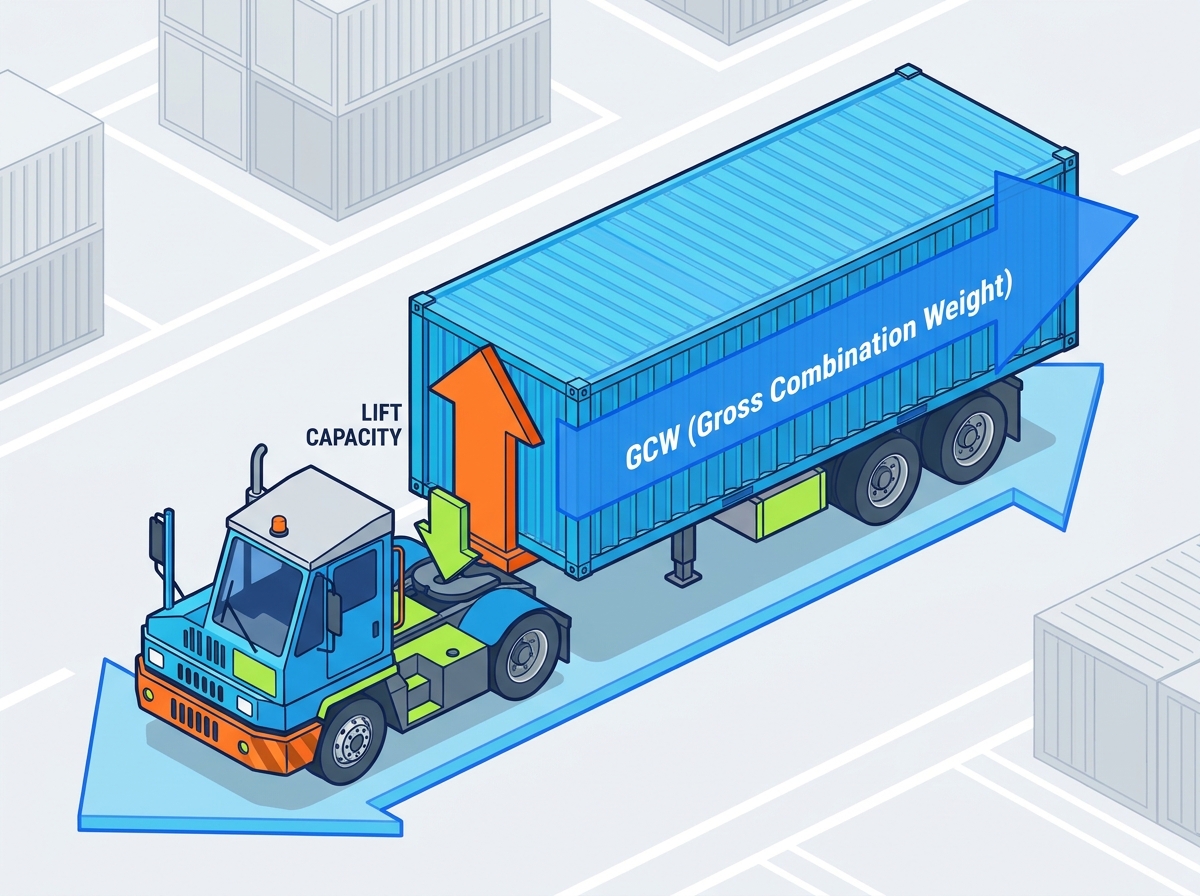
Many buyers confuse static load capacity with lift capacity. You must differentiate between the two. The fifth wheel can support massive structural weight. This static bearing capacity often exceeds 100,000 lbs. However, the hydraulic boom actually lifts a much lower amount. Typical lift ratings range from 70,000 to 80,000 lbs.
Robust lift capacity drives operational outcomes directly. It allows drivers to move trailers without adjusting the landing gear manually. Operators simply back under the trailer, lift the boom, and drive away. This feature translates directly to higher moves-per-hour (MPH) metrics. It also reduces operator injury claims. Manual cranking causes severe shoulder and back injuries over time.
Component durability relies heavily on boom design. Twin-cylinder designs distribute lifting forces evenly. They outlast single-cylinder designs in high-volume yards. Bushing durability also matters immensely. Frequent max-capacity lifts accelerate hydraulic wear and tear.
Common Mistake: Buying a lift rating exactly equal to your heaviest load.
Best Practice: Spec a 20% buffer above your average load to preserve hydraulic seals.
Maintenance Tip: Grease fifth-wheel pivot points weekly to prevent premature bushing failure.
The shift toward electric vehicles (EVs) changes capacity calculations fundamentally. Electric drivetrains affect towing dynamics in positive ways. Electric motors provide 100% torque at zero RPM. They offer superior initial pull for high-GCW loads compared to traditional diesel engines. This instant torque eliminates the sluggish start often seen when pulling heavy containers.
Evaluating a battery-swapping terminal tractor provides a unique solution for 24/7 operations. You eliminate long charging downtimes. However, you must address specific weight tradeoffs. Swapping mechanisms and dense battery packs add chassis weight. Does this extra weight eat into the allowable GCW? Yes, it slightly reduces the payload you can pull. It also alters the tractor’s center of gravity, making it heavier at the base.
Implementation carries distinct operational risks. You need dedicated infrastructure for battery swap stations. Operators also face a learning curve. Managing regenerative braking requires new driving habits. Heavy loads on steep grades push regenerative systems hard. Drivers must learn to modulate the pedal smoothly to prevent load shifting.
Selecting the right equipment requires a logical shortlisting process. Guesswork leads to expensive mistakes. Follow this step-by-step matrix for accurate evaluation:
Audit maximum trailer weight: Weigh your heaviest loaded trailers, not just the average ones.
Measure maximum yard grade: Use a digital inclinometer to find the steepest ramp or dock approach.
Determine required moves per shift: Calculate your target cycle times to understand hydraulic duty cycles.
Select drivetrain: Choose between Diesel, EV, or Battery-Swapping based on your shift schedule and emissions goals.
Ensure your chosen specs align with OSHA standards. Safety compliance protects your workforce and your budget. Follow local port authority regulations regarding maximum axle loads. Pay close attention to mandated braking distances for heavy equipment.
Maintain a balanced approach to capacity. Over-speccing buys durability, but it hurts your ROI. It results in higher upfront costs. It also potentially lowers energy efficiency because you move unnecessary chassis weight. Right-sizing remains the ultimate goal. Match the machine precisely to your daily operational reality.
GCW, fifth-wheel load, and lift ratings remain deeply interdependent. Failing to align all three metrics with actual yard conditions guarantees premature equipment failure. You cannot pull a heavy load up a steep grade if your GCW rating assumes a flat surface. You cannot achieve fast cycle times if your lift rating forces drivers to manually crank landing gear.
Take immediate action to protect your next procurement cycle. Conduct a physical yard audit this week. Measure your actual grades and record your maximum load weights accurately. Request a comprehensive site assessment from a qualified dealer before issuing an RFP. These proactive steps ensure you buy the exact capacity your yard demands.
A: Exceeding the lift rating triggers the hydraulic bypass valve, preventing the boom from rising. Repeatedly pushing this limit causes catastrophic seal failure. It also places severe structural stress on the boom assembly, leading to metal fatigue, cracked welds, and expensive hydraulic cylinder replacements.
A: No. A higher fifth-wheel load rating only increases the structural bearing capacity of the tractor's frame and fifth-wheel plate. It does not increase the total drivetrain pulling power. GCW depends entirely on engine torque, transmission gearing, and axle ratios.
A: The swapping mechanism and battery packs increase the tractor's base chassis weight. This slightly reduces the maximum payload you can tow within a strict GCW limit. However, the instant electric torque compensates for the heavier base, providing excellent pulling performance.
A: Industry standard lift heights typically range from 16 to 17 inches. This clearance matters greatly for irregular yard surfaces. Adequate lift height ensures the trailer landing gear clears steep dock ramps, potholes, and railroad crossings without dragging or causing structural damage.


