 English

Views: 0 Author: Site Editor Publish Time: 2026-09-14 Origin: Site


When you compare tractor trailer truck dimensions, is overall length enough? It is not. Fleet buyers must also review height, width, axle positions, ground clearance, axle ratings, gross vehicle weight, and trailer interface before placing an order.
These details affect loading access, route suitability, shipping arrangements, registration preparation, and quotation accuracy. This guide explains what to confirm before ordering a tractor truck for an export fleet.
Before ordering, ask the supplier to confirm these groups of information:
Overall dimensions: Length, width, and height of the configured tractor truck.
Layout measurements: Wheelbase, axle positions, fifth-wheel location, and ground clearance.
Weight information: Curb or tare weight, gross vehicle weight, front and rear axle ratings, and tire data.
Combination fit: Tractor-to-trailer interface, turning space, loading height, and overall combination envelope.
Market and delivery checks: Destination requirements, transport restrictions, shipping method, and required technical documents.
The right specification is not simply the shortest or lightest truck. It is the configuration that fits the intended route, trailer, loading area, legal requirements, and operating model.
Dimensions and weight affect different parts of the buying decision, but they are closely connected. A larger cab, fuel tank, axle group, or equipment package may change the vehicle's length, height, tare weight, axle distribution, or available installation space.
A truck that fits an open yard may still create problems at a loading dock, under a height restriction, inside a shipping arrangement, or during local registration. Similarly, a vehicle that appears suitable by overall size may need a different axle layout or trailer interface for the intended operation.
For this reason, buyers should request one coordinated specification sheet. Do not collect dimensions from one document and weight data from another version without confirming that both describe the same configuration.
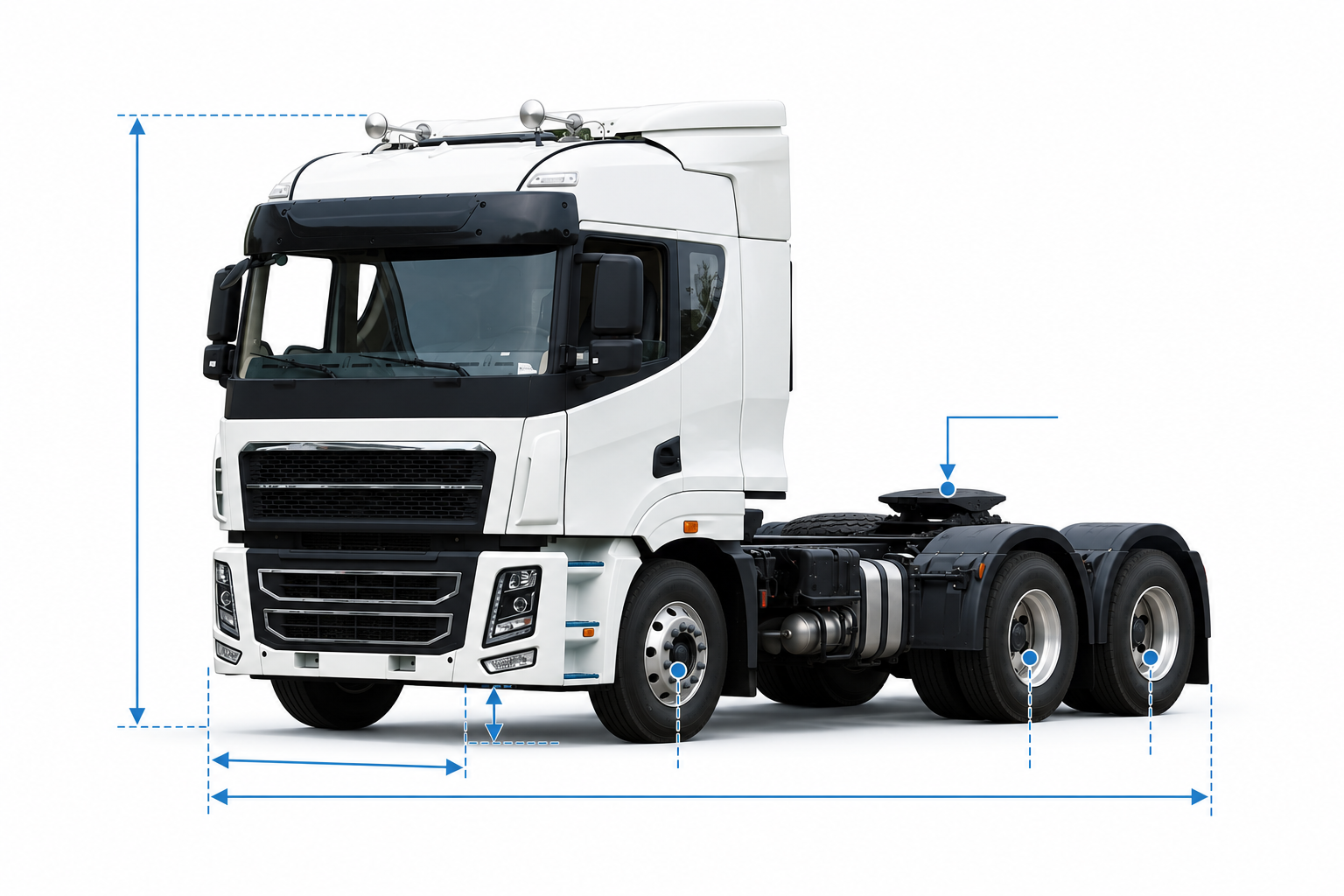
Overall length affects transport planning, turning space, loading access, parking, and the usable length of the tractor-trailer combination. Ask how the supplier measures the length and which equipment is included in the stated figure.
The measurement may change when the truck has a different cab, fuel tank, rear equipment, spare tire position, or coupling arrangement. A quotation should therefore identify the exact configuration behind the number.
Width affects road clearance, gate access, workshop space, loading areas, and transport handling. Check whether the stated width includes mirrors, side equipment, fenders, or other components that may extend beyond the main body.
The buyer should also compare the truck width with the available entrance, lane, ramp, warehouse, and service-bay clearances. A small difference can become important when the vehicle operates in restricted industrial or urban areas.
Overall height is important for bridges, tunnels, doors, loading bays, parking buildings, and shipping preparation. Confirm whether the measurement includes the cab roof, air equipment, exhaust components, roof accessories, or other high points.
Do not rely on a rounded height estimate when the route contains fixed overhead restrictions. Request the maximum configured height and clarify which equipment or optional components may change it.
Wheelbase and axle positions help buyers understand the vehicle's packaging, coupling location, turning envelope, and weight distribution. They should be recorded as layout information rather than treated as a complete maneuverability analysis.
The important question is whether the axle layout fits the planned trailer interface, loading area, and route. If the combination still needs to be selected, review the tractor truck and semi-trailer matching guide before finalizing the RFQ.
Ground clearance affects ramps, uneven access roads, loading areas, construction zones, and low-speed approach angles. Ask the supplier to define the measurement point and confirm whether the figure changes under the selected tire, suspension, or axle configuration.
Ground clearance is not the same as a general statement that a truck is suitable for rough roads. The buyer should match the actual clearance requirement to the route and site conditions.
The fifth-wheel position influences trailer connection, front clearance, combination length, and weight transfer. Buyers should confirm the coupling type, mounting position, adjustment range where applicable, and clearance around the cab and rear equipment.
This information is especially important when the tractor will work with more than one trailer type. The quotation should identify the assumed trailer interface instead of leaving the connection arrangement open.
Weight data can be confusing because suppliers and markets may use different terms. Before comparing the weight of a tractor trailer truck, ask the supplier to define each figure and state the measurement conditions.
Curb or tare weight normally describes the vehicle without the payload, but the exact included fluids, tools, spare wheel, driver equipment, and optional components may vary. Treat the figure as configuration-specific and confirm what is included.
This number helps buyers estimate the starting weight of the vehicle and its effect on the complete combination. It should not be used alone to determine legal payload or destination compliance.
Gross vehicle weight describes the maximum permitted weight of the individual vehicle under a specified configuration or regulatory system. The meaning and permitted value may vary by market, axle arrangement, documentation, and local rules.
The supplier should state whether the quoted figure is a product specification, a technical rating, or a market-specific legal value. Buyers should not transfer one country's limit directly to another country.
Axle ratings show how the vehicle's weight is allocated across the front and rear axle groups. They are important when evaluating chassis configuration, tire selection, trailer connection, and the expected operating arrangement.
A combined axle total should not automatically be treated as the legal weight of the complete vehicle. The buyer must also consider the manufacturer's specification, axle spacing, tire rating, local regulations, and the actual loaded condition.
Tire size, quantity, load rating, wheel arrangement, and spare-tire provision can affect both weight and dimensional clearance. Confirm that the tire specification in the quotation matches the intended route, axle arrangement, and destination requirements.
For export orders, also ask whether the tires, wheels, and related documentation are included in the quoted configuration. Do not assume that the tire shown in a product image is the tire included in every order.
The CAMC H9 tractor truck specifications provide a useful example of how model-level information can be organized. The stated configuration includes a diesel powertrain, 6×4 drive, 430 hp output, overall dimensions of 7140 × 2550 × 3700 mm, a 7.5 t front axle, a 16 t rear axle, and a listed gross vehicle weight of 8,805 kg.
These figures describe that specified configuration. They should not be treated as universal dimensions, legal limits, or a final configuration for every destination market. Buyers should confirm the final equipment, documentation, market requirements, and measurement basis before ordering.
The CAMC H9 example also shows why a product name alone is not enough for quotation comparison. A supplier must connect the model name to the exact drive form, axle data, dimensions, tires, equipment, and delivery assumptions.
The choice between 4×2 and 6×4 should not be reduced to a simple "better" or "worse" decision. It changes the number and position of drive axles, the chassis arrangement, the vehicle's weight distribution, and the space occupied by related components.
| Review Item | 4×2 Configuration | 6×4 Configuration |
|---|---|---|
| Drive axle layout | One rear drive axle | Two rear drive axles |
| Weight review | Often supports a lower tare-weight strategy, subject to equipment | May add axle-group and driveline weight, subject to configuration |
| Dimensional review | Check axle position, wheelbase, and coupling space | Check tandem axle spacing, rear clearance, and coupling space |
| Typical selection question | Is the route predictable and the required axle layout sufficient? | Does the route require the specified axle arrangement and traction capability? |
| Buyer evidence needed | Exact axle ratings, tires, dimensions, and market requirements | Exact axle ratings, tires, dimensions, and market requirements |
This comparison is limited to ordering and specification review. It does not replace a complete route, load, or regulatory assessment. Buyers can view the CAMC tractor truck category when comparing available configurations, then request the detailed data for the selected model.
A tractor truck is rarely purchased as an isolated object. The trailer connection affects overall combination length, turning clearance, front-wall clearance, fifth-wheel loading, and the usable space at loading locations.
Before ordering, confirm the following combination details:
trailer type and intended application;
kingpin and fifth-wheel compatibility;
expected front clearance between trailer and cab;
combination length and turning envelope;
loading-dock height and approach clearance;
axle spacing and weight-distribution assumptions;
parking, gate, ramp, and workshop requirements.
The tractor specification and trailer specification should be reviewed together. A truck may meet its individual dimensions while the complete combination creates clearance or access problems.
Use a common format when sending requirements to multiple suppliers. This helps prevent one supplier from quoting a base model while another quotes a market-adapted or higher-equipment configuration.
| Item to Confirm | Supplier Response Required | Buyer Check |
|---|---|---|
| Overall length | Exact measurement and included equipment | Compare with site, route, and combination needs |
| Overall width | Measurement basis and external components included | Compare with roads, gates, bays, and shipping access |
| Overall height | Maximum configured height and high-point components | Compare with overhead restrictions and loading areas |
| Wheelbase and axle positions | Axle spacing and layout drawing where available | Check trailer interface and operating envelope |
| Ground clearance | Measurement point and configuration basis | Check ramps, uneven roads, and site access |
| Front axle data | Rating and actual configuration | Review weight allocation and documentation |
| Rear axle data | Rating and axle-group arrangement | Review drive layout and trailer connection |
| Curb or tare weight | Included fluids, tools, tires, and options | Compare like-for-like vehicle specifications |
| Gross vehicle weight | Definition, rating basis, and market scope | Do not confuse with local legal limits |
| Tire specification | Size, quantity, rating, and wheel data | Confirm route, axle, and destination fit |
| Trailer interface | Coupling assumptions and clearance | Confirm complete combination compatibility |
Ask the supplier to attach the dimensional drawing, technical specification, equipment list, and weight definitions to the quotation. Written documentation reduces the risk of specification changes after the commercial discussion.
Search results often show approximate tractor trailer truck size figures. These can help with an initial understanding, but they cannot replace the exact dimensions of the selected model and equipment package.
Do not combine the dimensions of one cab with the axle data of another model. Confirm that every figure belongs to the same vehicle configuration and quotation.
A product image can show the general vehicle form, but it cannot reliably confirm height, width, clearance, axle spacing, or included equipment. Request a technical drawing or specification sheet for ordering decisions.
Axle ratings, gross vehicle weight, payload, and local legal limits are related but not identical. Keep the manufacturer's data separate from the rules that apply in the destination market.
Fuel tanks, tires, cab equipment, air systems, spare wheels, lighting, and other options can change the final dimensions or weight. Require the supplier to identify the configuration used for the quotation.
The tractor may fit the route by itself, but the complete combination may exceed available turning space, loading clearance, or parking space. Confirm the trailer interface before placing the order.
Tractor trailer truck dimensions and weight should be reviewed as a complete ordering package. Overall length, width, height, axle positions, ground clearance, fifth-wheel location, axle ratings, curb weight, gross vehicle weight, tires, and trailer compatibility all influence the final decision.
Fleet buyers should request one coordinated specification for the exact vehicle configuration. They should also separate manufacturer data from destination-market rules and avoid treating one model's figures as universal values.
Check overall length, width, height, wheelbase, axle positions, ground clearance, fifth-wheel position, and the dimensions of the complete tractor-trailer combination. Confirm the measurement basis for every figure.
Ask for curb or tare weight, gross vehicle weight, front and rear axle ratings, tire data, and the included equipment. The supplier should define each term and identify the exact configuration.
They use different drive axle layouts and chassis arrangements. This can change axle positions, rear clearance, weight distribution, tire requirements, and the space available for the trailer connection.
The trailer affects combination length, turning clearance, fifth-wheel loading, cab clearance, loading access, and axle distribution. Reviewing only the tractor can miss problems in the complete operating combination.
No. A product specification describes a defined vehicle configuration. Destination-market rules, registration requirements, optional equipment, measurement methods, and local operating conditions must be confirmed separately.


