 English

Views: 0 Author: Site Editor Publish Time: 2026-07-23 Origin: Site


Selecting the correct axle configuration dictates your fleet's operational efficiency. This choice directly impacts payload capacity, site access, and long-term viability on the job. Fleet managers frequently face the dilemma of balancing maximum payload requirements against site maneuverability. Over-specifying leads to wasted resources and increased maintenance downtime. Under-specifying results in regulatory fines, accelerated vehicle wear, and lost material volume per trip.
Resolving this requires a technical evaluation of different chassis layouts. You must understand how a dump truck operates under varying conditions, from paved highways to muddy excavation pits. This guide provides an evidence-based framework to compare axle layouts, payload distribution, and maneuverability constraints. We will help you determine the optimal chassis for specific operational demands, ensuring your equipment matches the reality of your daily haul routes.
Payload vs. Agility Trade-off: An 8x4 dump truck offers significantly higher gross vehicle weight (GVW) and payload capacity, while a 6x4 dump truck provides superior maneuverability and a tighter turning radius for restricted job sites.
Regulatory Compliance: The choice between configurations is heavily dictated by local bridge laws and axle weight limits; the extra axle on an 8x4 distributes weight more effectively to meet strict highway regulations.
Cost Implications: While 8x4 models generate higher revenue per trip in high-volume hauling, 6x4 models benefit from lower upfront acquisition costs, reduced tire wear, and better fuel efficiency under lighter loads.
Site Suitability: 6x4 configurations dominate general urban construction and flexible earthmoving, whereas 8x4 configurations are engineered for heavy-duty, long-distance highway hauling and large-scale infrastructure projects.
Heavy-duty hauling requires specific structural foundations. Lighter 4x2 or 6x2 layouts lack the necessary traction for rugged terrain and simply cannot handle the structural stress of continuous heavy loads. Highly specialized 10x4 multi-axle systems often prove too cumbersome for standard operations and require massive staging areas. The 6x4 and 8x4 layouts dominate the heavy-duty sector. They offer the best balance of structural integrity, load distribution, and mechanical reliability for daily abuse on construction sites.
When you look at a fleet yard, these two configurations make up the backbone of the operation. They provide the necessary framework to mount heavy steel or aluminum boxes, house massive hydraulic cylinders, and withstand the twisting forces of dumping uneven loads on unlevel ground. Understanding the mechanical differences between them is the first step in optimizing your hauling cycles.
The nomenclature defines the mechanical layout clearly. A 6x4 dump truck features six total wheel positions. Four of these positions are driven. The standard layout includes one front steering axle and two rear drive axles. This tandem drive setup provides excellent traction across various surface conditions.
This architecture serves medium-to-heavy load requirements perfectly. It balances traction, agility, and off-road capability. Operators rely on this layout for general construction tasks, residential deliveries, and municipal roadwork. The design ensures steady performance across uneven ground. The tandem rear axles articulate over ruts and rocks, keeping the tires planted and the power moving forward. The single steer axle allows for sharp wheel cuts, making it easier to thread the needle between parked cars, open trenches, and heavy equipment on crowded sites.
Mechanically, the 6x4 is straightforward. The driveline runs from the transmission to the forward-rear axle, and a short inter-axle driveshaft connects to the rear-rear axle. A power divider allows the driver to lock the axles together when traction gets sloppy. This simplicity translates to reliable performance and straightforward maintenance routines in the shop.
An 8x4 dump truck expands on this foundation. It features eight total wheel positions. Four positions remain driven. The standard layout varies based on regional regulations and specific hauling requirements.
Two front steering axles pair with two rear drive axles. This twin-steer setup dominates European and global markets, providing excellent weight distribution across the front half of the chassis.
One front steer axle joins an auxiliary lift axle and two rear drive axles. North American markets favor this design to comply with federal bridge laws, allowing the driver to lift the auxiliary axle when empty to save tires.
This configuration targets maximum legal payload transport over public highways. It requires advanced weight distribution across four axles. The design minimizes road damage while maximizing material volume per trip. When you are hauling aggregate from a quarry to an asphalt plant 50 miles away, the extra payload of the 8x4 means fewer trips to move the same tonnage. The chassis is longer, the frame rails are often double-channeled for extra strength, and the suspension systems are beefed up to handle the increased gross vehicle weight.
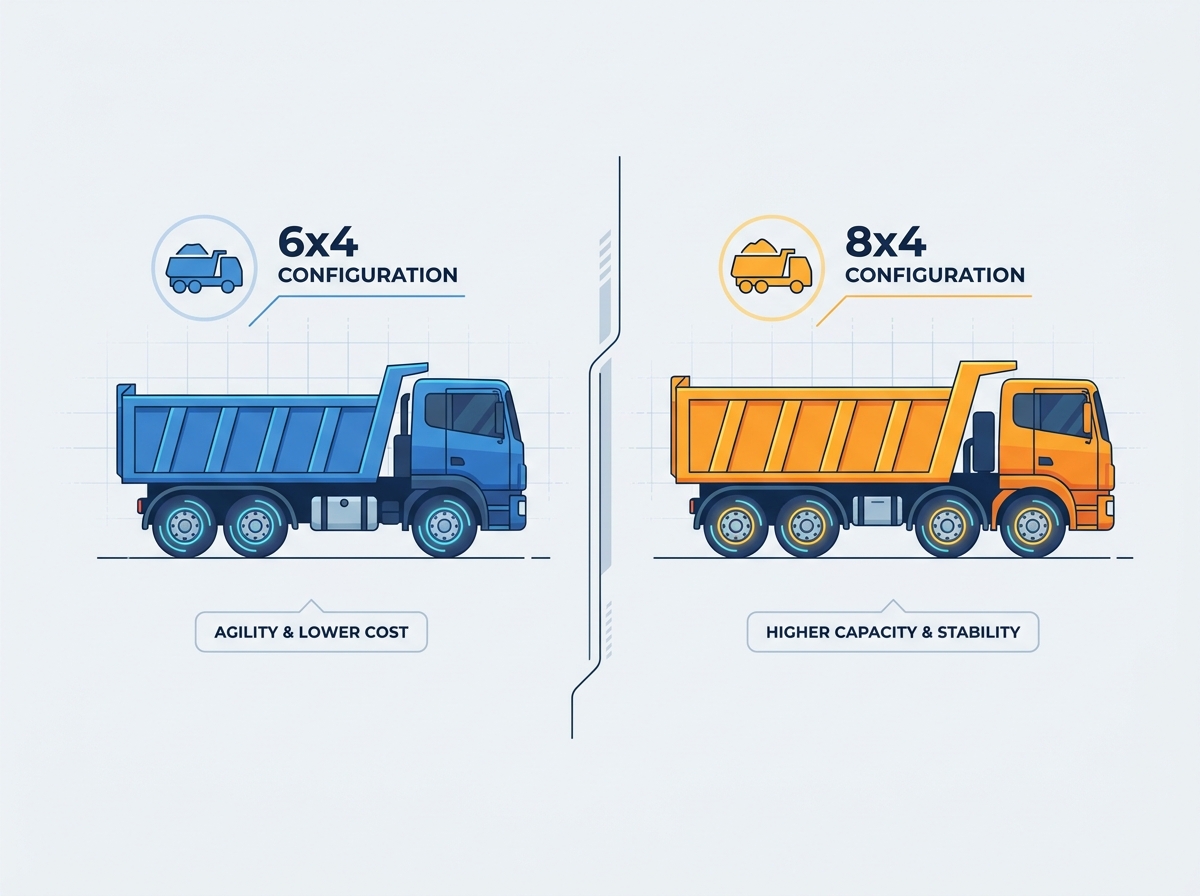
Gross Vehicle Weight (GVW) limits dictate operational boundaries. A standard three-axle configuration typically handles around 26 tonnes legally, depending on local statutes. A four-axle configuration can push this limit up to 32 tonnes or more under certain regulations. North American frameworks show comparable differences between tandem and tri-axle setups, heavily influenced by axle spacing and the Federal Bridge Formula.
The additional front axle increases legal payload significantly. This payload delta often ranges from 15% to 20% depending on jurisdiction. Proper weight distribution reduces chassis frame stress. It minimizes body roll and enhances stability during tipping operations. Operators must calculate these limits accurately to avoid structural failures. Overloading a 6x4 puts immense strain on the rear suspension and tires, increasing the risk of blowouts and broken leaf springs. The 8x4 spreads that burden, keeping individual axle weights within legal and mechanical tolerances.
When dumping, stability is paramount. A longer 8x4 chassis can be more stable on perfectly flat ground due to its wider footprint, but if the ground is uneven, the longer frame is subjected to severe torsional twisting. The shorter 6x4 frame is stiffer and less prone to twisting, making it slightly more forgiving if the driver misjudges the levelness of the dump pad.
Wheelbase dynamics directly influence site navigation. A three-axle chassis achieves a tighter turning circle than a four-axle chassis of comparable length. The twin-steer geometry introduces front-end scrubbing. It requires more physical space to navigate tight urban environments. The steering linkage on a twin-steer is complex, and the wheel cut angle is often restricted to prevent the tires from rubbing against the frame rails or steering components.
Site constraints dictate equipment selection. The agile three-axle setup excels in tight urban environments. It navigates residential zones and complex backfilling operations easily. You can back a 6x4 into a narrow driveway or swing it around a cul-de-sac without jumping curbs. The heavier four-axle setup struggles in confined spaces. Drivers must execute wider turns and require larger staging areas. If an 8x4 gets wedged in a tight spot, extracting it often requires stopping traffic and performing multiple reverse maneuvers, killing cycle times.
Ground pressure dynamics affect performance on loose surfaces. Weight distribution alters tire contact patches. The heavier twin-steer setup risks understeering in deep mud. The front axles can "plow" through soft ground rather than steering effectively. Because there is so much weight over the non-driven front axles, the truck wants to push straight ahead even when the wheels are turned.
The agile front end of a three-axle unit avoids this plowing effect. The traction-to-weight ratio favors the three-axle design in deep mud. When weight shifts rearward, the drive axles maintain maximum grip. This ensures continuous momentum across uneven terrain. If you are hauling muck out of a wet excavation pit, the 6x4 will claw its way out much easier than an 8x4. The 8x4's extra dead axle up front acts like an anchor in deep mud, dragging against the forward momentum generated by the rear drives.
Local and federal axle weight regulations dictate fleet choices. Laws like the US Federal Bridge Formula B rely heavily on axle spacing. You must distribute heavy loads across multiple axles to protect highway infrastructure. DOT officers target dump trucks specifically because they frequently run heavy. Getting pulled over and put on portable scales is a daily reality for highway haulers.
Running an under-specified vehicle near its maximum structural capacity introduces severe risks. Overweight penalties severely impact operational margins. The four-axle configuration provides a crucial safety margin for highway transport. Route planning must account for weight-limited bridges and municipal road restrictions. These constraints often limit the deployment of heavier units. You might have an 8x4 capable of hauling 20 tons of gravel, but if the only route to the job site includes a bridge posted for 15 tons, that truck is useless for that specific job.
Compliance isn't just about avoiding fines; it is about liability. If a truck is involved in an accident and is found to be overweight for its axle configuration, the legal fallout is massive. Fleet managers must match the truck's legal capacity to the specific routes it will run. This often means keeping a mix of 6x4 and 8x4 trucks in the fleet to handle different types of dispatch requests.
Different environments demand specific mechanical solutions. You must match the vehicle to the primary operational environment. Sending the wrong truck to a job site ruins productivity and frustrates site superintendents.
Urban Construction and Residential Development: Spatial constraints define these sites. Frequent stops and moderate payload needs make the agile three-axle unit the standard choice. They can navigate narrow streets, dodge parked cars, and back up to foundation walls without tearing up the surrounding grade.
Highway Paving and Aggregate Hauling: Continuous, high-volume material transport requires maximum capacity. Transporting asphalt, sand, or gravel over paved surfaces favors the four-axle unit. When feeding a paving machine, the 8x4 holds more asphalt, meaning fewer truck exchanges in front of the paver, resulting in a smoother mat.
Mining and Heavy Earthmoving: Specialized off-road conditions test vehicle limits. Heavy-duty rigid four-axle units provide efficient bulk transport on maintained haul roads. In these environments, the roads are graded and wide, negating the maneuverability disadvantages of the larger truck.
| Feature | 6x4 Configuration | 8x4 Configuration |
|---|---|---|
| Driven Axles | 2 (Tandem Rear) | 2 (Tandem Rear) |
| Steering Axles | 1 | 2 (Twin-Steer common) |
| Maneuverability | High (Tight turning radius) | Low (Wider turning radius) |
| Highway Payload | Moderate | Maximum Legal Limit |
| Off-Road Agility | Excellent | Moderate (Risk of plowing) |
| Tire Wear (Front) | Normal | High (Scrubbing on tight turns) |
Fuel burn rates differ significantly between the two setups. The 8x4 carries a heavier tare weight. That extra axle, suspension hardware, and longer frame add thousands of pounds of dead weight. This means the engine works harder just to move the empty truck. Furthermore, the extra tires create more rolling resistance on the pavement.
However, you must measure fuel efficiency by the ton hauled, not just miles per gallon. When fully loaded, the 8x4 moves more material per gallon of diesel burned than the 6x4. If your operation involves long highway runs with heavy materials, the 8x4 is more efficient. If your operation involves short runs, frequent stops, and lots of empty return miles, the 6x4 will burn less fuel overall.
Maintenance schedules look different for these two trucks. The twin-steer 8x4 setup experiences significant tire scrubbing on the front axles during tight maneuvers. Because the two front axles turn at slightly different arcs, the tires drag laterally across the pavement. This shreds steer tires quickly if the driver constantly navigates tight urban corners.
Brake lining wear, front alignment maintenance, steering linkage lubrication, and suspension upkeep increase with the four-axle configuration. You have more moving parts, more grease zerks to hit, and more brake chambers to monitor. The 6x4 is simpler. Mechanics can perform preventative maintenance faster, getting the truck out of the bay and back on the road. When a 6x4 needs a front-end alignment, it is a standard procedure. Aligning a twin-steer 8x4 requires specialized equipment and more labor hours.
Operating complex machinery requires skilled personnel. The steeper learning curve for twin-steer vehicles challenges new operators. Drivers must manage larger blind spots and wider turning arcs. Steering wheel resistance differs significantly under heavy loads. The power steering pump works overtime to turn four heavy tires instead of two. If the truck gets into soft dirt, turning the wheel requires serious effort.
You must implement specific training protocols for 8x4 operators. They need to understand how to swing wide for intersections and how to manage the truck's momentum. Putting an inexperienced driver in an 8x4 often results in clipped curbs, damaged street signs, and blown steer tires from aggressive dry-steering.
Site accessibility failures present a major operational risk. Deploying a massive four-axle unit to a site it cannot navigate causes severe delays. The truck gets stuck, blocks other equipment, and forces the site superintendent to halt operations. You must mitigate this risk through strict pre-dispatch site audits.
Dispatchers need to ask the right questions before sending a truck. Is the dump area paved or dirt? How wide is the gate? Are there overhead power lines? Digital route modeling helps confirm turning clearances before the vehicle leaves the yard. If the site is tight, send the 6x4, even if it means making an extra trip. The time lost to an extra trip is nothing compared to the time lost extracting a stuck 8x4 from a muddy residential lot.
The choice between these configurations relies on strict alignment with operational environments. You must evaluate your specific regulatory weight limits, typical haul routes, and the physical constraints of your job sites.
Audit your most frequent haul routes for specific axle weight restrictions and bridge limits.
Measure the turning clearance and staging areas of your primary job sites to ensure larger trucks can maneuver safely.
Evaluate your typical material density to determine true payload requirements versus legal axle limits.
Implement digital route modeling for complex urban deliveries to prevent site access failures.
Establish a specialized driver training program if you plan to integrate twin-steer configurations into your fleet.
A: A three-axle unit provides a significantly tighter turning radius. The single steer axle and shorter effective wheelbase allow it to navigate confined urban job sites and narrow residential streets easily.
A: Yes, but it requires maintained, hard-packed haul roads. In deep mud or loose dirt, the twin front axles tend to plow straight ahead, reducing steering effectiveness compared to a lighter three-axle setup.
A: Bridge laws strictly limit the amount of weight a single axle can carry. A four-axle unit distributes the total gross weight over more axles, allowing you to haul heavier legal payloads on public highways without facing overweight fines.
A: It requires specific training and awareness. Drivers must account for a wider turning arc, increased steering resistance in soft ground, and altered blind spots compared to standard single-steer vehicles.
A: The three-axle unit is superior for residential construction. It easily navigates narrow neighborhood streets, tight driveways, and complex backfilling zones without causing excessive ground damage or getting stuck.
A: Yes. The additional axle means more tires to replace, more brakes to service, and more steering linkages to grease. Twin-steer setups also experience faster front tire wear due to scrubbing during tight turns.


