 English


Views: 0 Author: Site Editor Publish Time: 2026-11-10 Origin: Site


Securing the right concrete mixer truck requires balancing maximum payload economics against strict structural and legal limits. If you misjudge capacity, it leads to accelerated chassis wear, heavy regulatory fines, and inefficient dispatching. Procurement teams frequently make a critical error during the purchasing phase. They conflate a drum’s total geometric volume with its actual safe mixing capacity. Furthermore, buyers often fail to account for how base chassis weight directly restricts the legally transportable yardage on public roads.
This guide breaks down the complex technical relationship between drum sizing, rated load, and strict axle weight limits. You will learn how to navigate bridge laws, evaluate heavy battery penalties, and match drum sizes to job site realities. We aim to support a highly confident, evidence-based fleet purchasing decision for your next equipment investment.
Geometric vs. Rated Volume: A drum’s total volume is typically 30–40% larger than its maximum safe mixing capacity to allow for proper concrete agitation without spillage.
Axle Compliance Dictates Payload: True transport capacity is limited by local bridge laws and gross vehicle weight ratings (GVWR), not just the size of the drum.
EV Trade-offs: An electric concrete mixer truck offers significant emission and noise reductions, but battery weight can impact the maximum legal payload.
Selection Logic: Successful mixer truck selection aligns rated capacity with average local batch sizes, site accessibility, and regional axle regulations.
Manufacturers use distinct measurements to specify mixer drum sizes. Relying on the wrong metric creates severe operational risks. You must understand these differences to avoid purchasing equipment incapable of meeting your daily delivery targets. Misinterpreting a spec sheet often results in undersized loads or dangerous spillage.
Geometric volume represents the absolute total internal space of the empty drum. Engineers calculate this by measuring the complete physical dimensions of the steel shell. However, filling a drum to its geometric limit remains physically and operationally impossible.
Wet concrete requires significant empty space to tumble and fold. If you fill the drum completely, it leaves no room for the mixing action. The internal spiral blades cannot fold the material properly. Furthermore, guaranteed concrete spillage will occur the moment the vehicle encounters an incline, a sharp turn, or sudden braking.
Rated load serves as the manufacturer-certified maximum volume of wet concrete the truck can effectively mix and transport. Industry standards typically measure this in cubic yards or cubic meters. This metric represents the true working capacity of your equipment.
Mixing capacity generally hovers around 60–70% of the total geometric volume. This 30–40% void space allows the concrete to slide up the drum walls and fold back over itself. This continuous folding action prevents premature setting and ensures a homogenous mix design upon delivery. When you evaluate fleet upgrades, you must base your calculations strictly on this rated load.
Agitation capacity applies when transporting pre-mixed concrete from a central mix plant. In this scenario, the plant already mixes the concrete thoroughly. The truck drum merely agitates the material slowly to prevent separation during transit. Agitation capacity is typically slightly higher than mixing capacity. However, it still falls well below the absolute geometric volume to prevent spillage on public roads.
Drum Capacity Measurement Standards
| Metric Type | Technical Definition | Operational Purpose | Average Percentage of Total Space |
|---|---|---|---|
| Geometric Volume | Total internal empty space of the steel shell. | Engineering baseline; not used for loading. | 100% |
| Rated Mixing Capacity | Maximum volume of unmixed materials it can homogenize. | Standard transit-mix delivery loading limit. | 60% – 70% |
| Agitation Capacity | Maximum volume of pre-mixed wet concrete it can haul safely. | Central-mix plant delivery loading limit. | 70% – 80% |
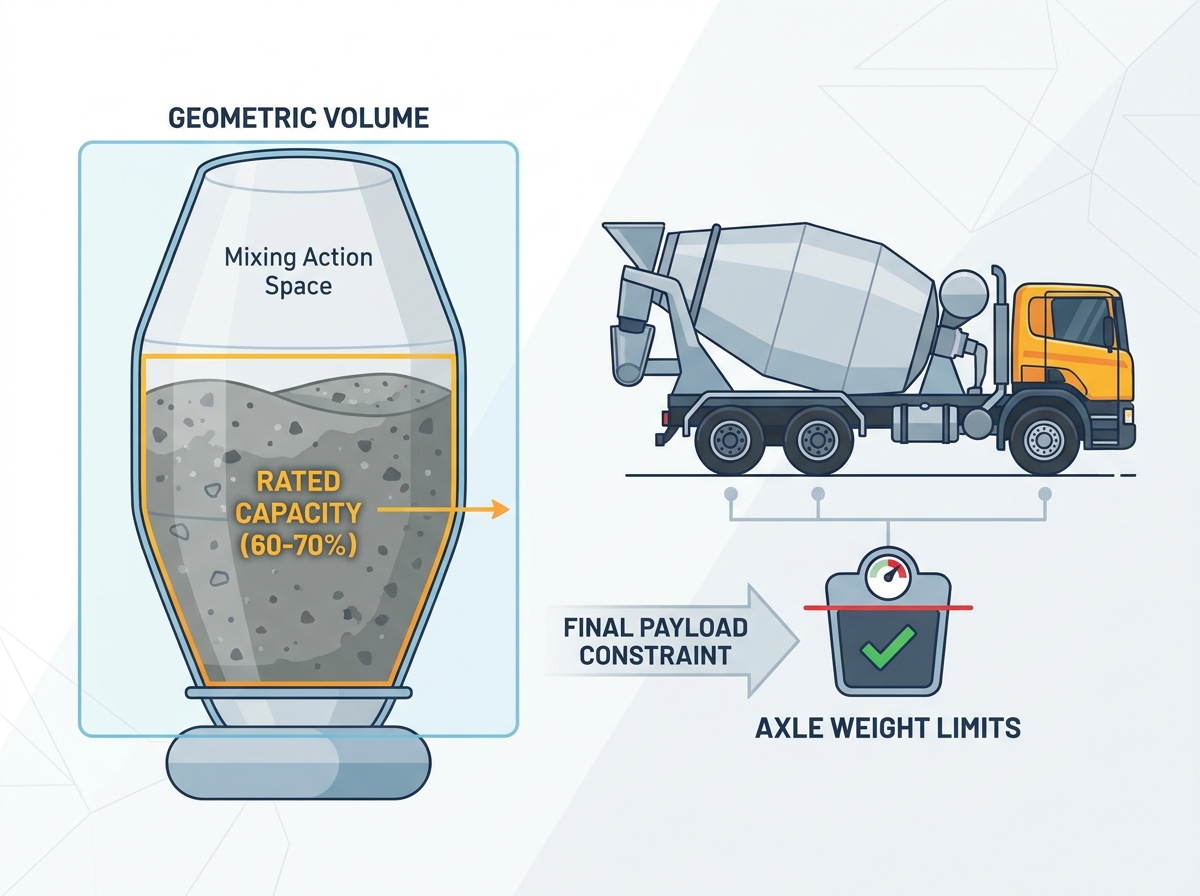
A truck might feature a 10-cubic-yard rated drum. However, filling it fully might easily exceed the chassis or road weight limits. When this happens, local regulations artificially reduce your usable capacity. You cannot legally transport what the drum can physically hold.
Gross Vehicle Weight (GVW) and individual axle weight ratings determine your true legal payload. A standard cubic yard of concrete weighs approximately 4,000 pounds. If you load 10 yards, you add 40,000 pounds of payload to a truck that already weighs 25,000 to 30,000 pounds empty.
Federal and regional bridge formulas heavily impact legal transport. These formulas establish the strict relationship between the number of axles, axle spacing, and maximum allowable weight. They prevent heavy vehicles from damaging highway bridges and local infrastructure.
To maximize legal load sizes, operators rely on multi-axle configurations. A standard 3-axle truck may only legally carry 6 or 7 yards in strict jurisdictions. To haul 10 or 11 yards legally, you often need 4-axle or 5-axle models equipped with pneumatic drop axles (pusher or tag axles). These extra axles distribute the immense weight over a larger footprint, satisfying the bridge formula requirements.
Prioritizing drum fill over strict axle limits introduces severe operational and legal risks. Overloading is never a sustainable business strategy. It exposes your fleet to the following penalties:
Severe DOT Fines: Highway patrols actively target heavy construction vehicles. Overweight tickets can cost thousands of dollars per incident and damage your carrier safety rating.
Voided Warranties: Manufacturers closely monitor equipment usage. Consistent overloading immediately voids chassis and drivetrain warranties, leaving you responsible for catastrophic repair bills.
Increased Rollover Risk: Wet concrete acts as a dynamic, shifting load. Excess weight raises the center of gravity. This exponentially increases the risk of a fatal rollover during cornering.
Accelerated Mechanical Wear: Pushing a vehicle past its Gross Vehicle Weight Rating (GVWR) destroys critical components. You will experience premature failures in brakes, air suspensions, and commercial tires.
As fleets evaluate decarbonization, assessing how electrified chassis alter traditional capacity math remains critical. Transitioning to zero-emission vehicles introduces new engineering challenges. You must understand how battery mass impacts your daily delivery volumes.
Commercial EV batteries add significant tare weight to the base chassis. Heavy-duty battery packs require dense lithium-ion configurations and robust thermal management systems. This extra hardware weighs thousands of pounds more than a traditional diesel engine and transmission.
This increased empty weight directly reduces the maximum allowable concrete payload. Because local bridge laws cap the maximum Gross Vehicle Weight, every extra pound of battery means one less pound of wet concrete. Compared to a diesel equivalent, an electric concrete mixer truck hits its legal axle limit much faster.
Adopting electric chassis technology requires a balanced evaluation framework. You must weigh the structural payload limitations against the immense operational benefits of electrification.
Operators typically observe a potential loss of 0.5 to 1 cubic yard of payload per trip. You must balance this reduction against massive drops in daily diesel consumption. Electric motors operate with high efficiency and eliminate costly engine idling at job sites. Furthermore, electric powertrains require significantly less routine maintenance. They lack complex exhaust aftertreatment systems, oil changes, and traditional transmission repairs.
Finally, consider the regulatory environment. Urban centers increasingly mandate zero-emission zones. Accepting a slight payload drop guarantees your fleet maintains unrestricted access to lucrative downtown development projects. You trade a small fraction of yardage for long-term regulatory compliance and reduced noise pollution.
A robust mixer truck selection framework synthesizes complex technical data into a clear procurement process. You cannot buy equipment based solely on drum size. You must follow a structured approach to maximize efficiency.
You must base the baseline chassis and drum size on the strictest local weight regulations. Research the specific bridge formulas and seasonal weight restrictions in your primary operating radius. Some northern regions enforce strict spring thaw weight limits. If you operate across state or provincial lines, spec your vehicles to comply with the most restrictive jurisdiction you serve.
Assess maneuverability before finalizing capacity. A massive 12-yard multi-axle truck maximizes payload efficiency for heavy highway pours. However, it may prove useless for tight residential developments. Long wheelbases struggle to navigate cul-de-sacs, narrow alleys, and congested urban job sites.
Evaluate your historical batch data rigorously. Buying maximum capacity yields poor returns if the truck frequently runs half-empty. If your average customer order size is 6 yards, purchasing an 11-yard truck wastes fuel and increases tire wear unnecessarily. Match your drum capacity to your most frequent order volume.
Ensure you explicitly rate the truck chassis to support the dynamic load of the chosen drum. Wet concrete shifts continuously during transit. This shifting center of gravity places immense torsional stress on the frame rails.
You must match the drum size to the specific axle ratings at maximum rated mixing capacity. Never mount a high-capacity drum on a standard-duty chassis. Work closely with both the truck dealer and the body builder. They will perform a weight distribution calculation to ensure the front steer axle and rear drive axles remain compliant when fully loaded.
Optimal concrete delivery capacity is never found by simply selecting the largest drum available on the market. It requires a precise, engineering-based calculation of mixing volume, chassis tare weight, and regional axle restrictions. Ignoring any of these factors leads to regulatory penalties, premature equipment failure, and lost profitability.
As you prepare for your next procurement cycle, take immediate action. Conduct a comprehensive fleet audit comparing your average delivery volumes against local weight regulations. Review your job site accessibility constraints and evaluate the payload impacts of emerging electric chassis technology. By mapping these operational realities first, you can request accurate, customized spec sheets and quotes from manufacturers.
A: Geometric volume measures the absolute total internal space of the empty steel drum. Mixing volume represents the safe operating limit required to mix concrete without spilling. Mixing volume usually accounts for only 60-70% of the total geometric volume. The remaining empty space allows the wet concrete to tumble, fold, and mix properly during transit.
A: Empty trucks typically weigh between 20,000 and 30,000 lbs depending on the chassis and axle configuration. Wet concrete weighs roughly 4,000 lbs per cubic yard. Therefore, a fully loaded 10-yard truck frequently exceeds 60,000 to 70,000 lbs. This immense weight requires specific multi-axle configurations to remain legal on public roads.
A: Generally, yes. Commercial battery packs are exceptionally heavy. They increase the empty tare weight of the vehicle significantly. Because local bridge laws cap the maximum allowable gross vehicle weight, this heavier chassis slightly reduces the maximum legal payload capacity. Operators often see a reduction of 0.5 to 1 cubic yard.
A: You must balance your region's legal axle weight limits against your most common order sizes. Analyze your historical batch data to find your average yardage per delivery. Then, evaluate the physical access constraints of your typical job sites. Large multi-axle trucks maximize highway payload but struggle in tight residential neighborhoods.


