 English

Views: 0 Author: Site Editor Publish Time: 2026-07-11 Origin: Site


Urban emissions regulations are rapidly tightening worldwide. Strict noise ordinances now dictate when and how construction sites operate. These shifting rules are driving a massive transition toward heavy-duty electric vehicles. Contractors face a significant dilemma today. You must balance immediate environmental benefits against high upfront capital costs. You also have to navigate complex new charging infrastructure realities. How do you decide if an electric fleet makes sense?
We wrote this guide to establish an objective, evaluation-first approach to fleet electrification. We break down operational viability and identify key deployment risks. Our goal is to help your procurement teams make data-driven decisions. You will learn exactly where battery-powered heavy machinery succeeds. You will also understand the payload trade-offs and charging logistics required for real-world success.
Electric mixer trucks excel in short-haul, urban readiness applications where noise reduction and zero-emissions win commercial bids.
The initial CapEx is significantly higher than diesel, but lower variable costs (fuel and powertrain maintenance) heavily influence long-term ROI.
Battery weight introduces strict payload management challenges to comply with local axle weight restrictions.
Successful deployment requires parallel investments in depot charging infrastructure and grid capacity analysis.
Electric heavy machinery does not fit every single construction scenario yet. However, an electric concrete mixer truck thrives in specific environments. Inner-city projects are the most obvious fit. Urban centers increasingly enforce zero-emission zones. Underground construction also demands clean equipment to maintain safe air quality. Night-time pours benefit heavily from battery operation. Diesel engine noise often violates local residential noise ordinances after dark. Electric drivetrains eliminate this barrier entirely. This allows contractors to operate around the clock in densely populated areas.
Traditional diesel trucks use a mechanical Power Take-Off to spin the mixing drum. Electric models handle this differently. The high-voltage battery system powers both the main drivetrain and the continuous drum rotation. This creates a dual-draw on the battery reserves. Drum rotation requires constant energy to prevent concrete segregation during transit. Manufacturers factor this continuous power drain into the official range estimates. Operators must monitor this dual-draw closely. Extended traffic delays require the drum to keep spinning, which slowly chips away at the remaining driving range.
Adopting zero-emission equipment is no longer just a public relations move. It directly impacts your bottom line. Government agencies and large corporate developers now enforce strict Environmental, Social, and Governance (ESG) mandates. They award lucrative contracts to construction firms demonstrating real sustainability efforts. Bidding proposals often require contractors to detail their carbon footprint. Deploying electric machinery gives you a massive competitive advantage. It proves your fleet meets forward-looking sustainability requirements.
Electric motors deliver immediate, maximum torque from zero RPM. This characteristic fundamentally changes how operators handle heavy machinery. A fully loaded mixer truck struggles on muddy or uneven job sites. Diesel engines require high revs to generate enough torque to escape deep mud. This risks wheel slip and loss of traction. Electric motors apply smooth, instant power to the wheels. This improves low-speed maneuverability significantly. Operators gain precise control over the vehicle when navigating tight construction corridors.
Fleet managers see the biggest operational differences in the service bay. Electric drivetrains simplify routine maintenance drastically. You eliminate diesel engine oil changes completely. You no longer need to replace Diesel Particulate Filters (DPF). Exhaust system repairs disappear. However, the high-voltage architecture introduces new service requirements. Technicians need specialized diagnostic training. They must know how to safely isolate battery packs before performing suspension or brake work.
| Maintenance Component | Traditional Diesel Fleet | Electric Fleet |
|---|---|---|
| Engine Oil & Filters | Frequent replacement required | Completely eliminated |
| Exhaust & Emissions (DPF) | High failure rate, costly cleanouts | Completely eliminated |
| Brake Pad Wear | High wear due to heavy loads | Significantly reduced via regen braking |
| Diagnostic Needs | Standard mechanical troubleshooting | High-voltage electrical diagnostics |
Uptime is the ultimate metric for any fleet operation. Electric trucks rely on regenerative braking during heavy load scenarios. This system captures kinetic energy on downhill descents and sends it back to the battery. It saves brake pads and extends driving range. However, fleet managers must acknowledge the risk of unproven long-term battery degradation. Heavy-duty cycles put immense thermal stress on battery cells. We recommend securing performance warranties from manufacturers to guarantee battery capacity over the vehicle lifespan.
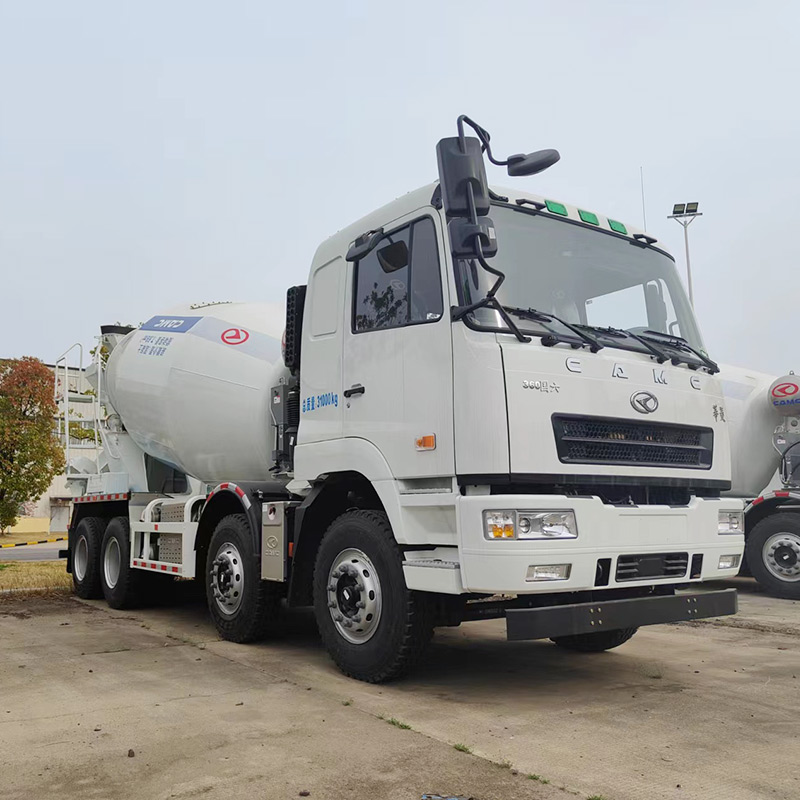
Battery mass is an unavoidable reality in heavy-duty electrification. Massive lithium-iron-phosphate (LFP) battery packs weigh thousands of pounds. This weight directly impacts your profit margins. Transportation authorities enforce strict Gross Vehicle Weight (GVW) limits on public roads. Every extra pound of battery subtracts from your maximum allowable payload. You cannot simply overload the truck. Doing so invites severe regulatory fines and compromises vehicle safety. Procurement teams must calculate exactly how much concrete they can legally carry per trip.
To solve the weight penalty, fleet engineers rely on specialized chassis designs. This is why the 8X4 concrete mixer truck configuration is critical for electric models. An 8X4 setup features dual steering axles in the front and dual drive axles in the rear. This eight-wheel, four-wheel-drive design distributes massive weight evenly across the chassis. It allows the truck to carry the heavy battery pack and a full volumetric load of concrete simultaneously. The extra axles keep the vehicle street-legal. They ensure the weight per axle remains safely below municipal road damage thresholds.
Fleet operators must run precise mathematical models to find their break-even point. You will likely carry slightly less concrete per trip compared to a lightweight diesel counterpart. However, the cost savings per mile often offset this loss. Electricity typically costs less than diesel fuel. Reduced maintenance downtime keeps the truck on the road longer. You trade a minor volume reduction for massive operational efficiency gains over the long term.
Procuring a zero-emission heavy truck requires significant upfront capital. The initial purchase price remains substantially higher than standard diesel models. High-capacity battery packs dictate this premium pricing. Equipment financing specialists strongly advise against evaluating these trucks purely on sticker price. You must view the purchase as a long-term utility investment. Securing favorable financing terms is essential to absorb the initial CapEx shock.
The financial recovery begins the moment the truck enters service. OpEx models project heavy savings through electricity pricing. Commercial electricity rates generally experience less volatility than global diesel markets. You can forecast your energy expenses with greater accuracy. Furthermore, you eliminate preventive maintenance downtime associated with diesel engines. Keeping the truck actively pouring concrete instead of sitting in the repair shop generates more revenue per week.
Conduct an energy audit: Compare local commercial electricity rates against historical diesel costs.
Calculate maintenance reductions: Subtract annual oil, filter, and belt replacement costs from your budget.
Factor in increased uptime: Estimate the revenue gained by avoiding DPF regeneration downtime.
You rarely have to pay the full retail price out of pocket. Many regional governments offer commercial fleet electrification grants. These financial incentives are designed to close the acquisition gap. Tax credits and accelerated depreciation schedules improve your balance sheet rapidly. Procurement teams must research all available federal and local subsidies before signing a purchase agreement. Missing out on a grant can drastically extend your return on investment timeline.
Hidden costs often surprise eager contractors. Transitioning to electric machinery means becoming your own fuel station. You must upgrade your batch plant depot to handle massive electrical loads. Installing commercial-grade DC fast-charging stations is expensive. You may also need utility grid upgrades to bring enough power to your facility. Always factor these infrastructure costs into your initial financial modeling to avoid budget overruns.
You cannot dispatch a battery-powered heavy vehicle blindly. Route predictability is mandatory. Dispatchers must calculate the exact distance from the batch plant to the job site. You must account for heavy traffic and idle times. The mixing drum drains power continuously while sitting in gridlock. Intelligent route planning software helps mitigate range anxiety. Drivers must follow strict navigation paths to ensure they return to the depot with a safe battery buffer.
Managing your charging schedule requires extreme precision. Fleet operators utilize two primary methods.
Overnight Depot Charging (Level 2): Trucks plug in at the end of the shift. This provides a slow, battery-friendly charge during off-peak electricity hours.
Opportunity Charging (DC Fast Charging): Trucks plug into high-powered chargers while reloading at the batch plant. This blasts the battery with energy in 30 minutes, extending the daily functional range.
Extreme temperatures present a major implementation risk. Freezing weather severely impacts lithium-ion cell chemistry. The chemical reactions slow down, causing a noticeable reduction in total range. Furthermore, heating the truck cabin for driver comfort draws heavy power directly from the battery pack. Some systems also use energy to keep the battery thermally conditioned. Operators in northern climates must reduce their range expectations by up to 20% during deep winter months.
Procurement teams need a practical checklist before contacting manufacturers. First, conduct a thorough route distance audit. Analyze your typical delivery radius. Second, evaluate your facility's electrical capacity. Can your current grid connection support high-voltage chargers? Third, research local grant availability. Finally, review your client base. Do your primary clients enforce ESG demands? If your urban routes are short and your clients demand green operations, you are an ideal candidate.
Never replace your entire fleet at once. We strongly recommend leasing or purchasing a single pilot unit first. A pilot program allows your team to test batch-plant integration safely. You can measure actual charging times against manufacturer claims. Your dispatchers will learn how to route the vehicle efficiently. Operators get comfortable with the immediate torque and regenerative braking. Once the single unit proves profitable, you can commit to fleet-wide capitalization.
Choosing the right OEM is critical when buying a new concrete mixer truck. You are buying a complex technology ecosystem, not just a chassis. Demand comprehensive battery warranties that guarantee capacity retention over time. Insist on guaranteed uptime Service Level Agreements (SLAs). The best manufacturers provide charger installation partnerships to simplify your infrastructure upgrades. Finally, require specialized operator training directly from the vendor to ensure safe handling of high-voltage systems.
Transitioning to an electric construction fleet involves far more than a simple vehicle purchase. It requires a fundamental shift in operational logistics, route planning, and energy management. While the technology is absolutely ready for short-haul urban routes, success depends entirely on preparation. You must validate your local charging infrastructure and strictly calculate your payload economics before deploying units.
The upfront costs are undeniably higher, but the long-term efficiency gains and bidding advantages are substantial. Start small and measure everything. We encourage contractors to schedule a comprehensive fleet operational audit today. Consult with equipment financing specialists to map out a phased, data-driven electrification strategy that protects your profit margins while modernizing your operations.
A: The mixing drum relies on an electric Power Take-Off (PTO) connected directly to the high-voltage battery. It draws continuous energy to prevent concrete segregation during transit and waiting periods. Manufacturers calculate this steady drain into their official range estimates, but heavy traffic delays will reduce your total driving distance.
A: Job site charging is currently highly limited. Most active construction sites lack the high-voltage infrastructure required for DC fast charging. Fleets must rely entirely on batch-plant depot chargers for overnight recovery and opportunity charging between loads.
A: Reputable manufacturers typically offer battery warranties covering 5 to 8 years, or a specific number of charge cycles. Heavy-load stress, extreme temperatures, and frequent fast-charging accelerate cell degradation. Proper thermal management and overnight slow-charging help maximize battery longevity.
A: Standard Commercial Driver's License (CDL) requirements remain exactly the same based on the gross vehicle weight class. However, operators do require specialized vendor training to understand high-voltage safety protocols, manage immediate torque delivery, and optimize regenerative braking techniques.


