 English

Views: 0 Author: Site Editor Publish Time: 2026-07-25 Origin: Site


Tire failure on active job sites dictates the line between profitable hauling and costly unplanned downtime. Heavy-duty hauling operations face harsh realities daily, where tire-related issues stand as a leading cause of immobilized equipment. Rough, unpaved sites featuring deep mud, jagged rock, and steep grades present extreme variables that standard highway tires simply cannot handle. Operating standard treads in these environments guarantees poor traction, compromised load stability, and accelerated tire destruction.
Selecting the correct tire tread design requires a highly technical evaluation rather than a generic purchasing decision. Fleet managers must analyze site conditions to match tread geometry with operational demands. This careful selection process directly impacts a dump truck regarding its safety, fuel efficiency, and long-term operational viability. Understanding the mechanics behind tread patterns allows operators to maximize performance while minimizing catastrophic tire failures on unforgiving terrain.
Tread geometry dictates site capability: Deep voids and open shoulders are mandatory for mud evacuation, while closed shoulders and specialized compounds are required for high-abrasion rock environments.
Axle-specific matching is critical: Steer, drive, and lift/trailer axles require distinct tread patterns to balance steering response with forward traction.
Configuration impacts wear: The weight distribution differences between a 6x4 and an 8x4 dump truck necessitate specific tread depth and block rigidity to prevent irregular wear.
Lifecycle cost outweighs initial price: Evaluating tire removal mileage and casing retreadability provides a more accurate ROI than upfront procurement costs.
Defining the baseline performance metrics required for hauling operations on rough terrain establishes clear success criteria for tire selection. Operators demand continuous forward momentum through challenging ground conditions. Lateral stability under heavy loads prevents rollovers on uneven grades, while high puncture resistance ensures the vehicle remains operational across debris-littered sites. Meeting these baseline metrics requires specialized rubber compounds and engineered tread geometries designed specifically for off-road abuse. Without these features, vehicles lose traction, slide laterally, and suffer frequent flats that halt site progress.
Field supervisors measure success by the number of uninterrupted cycles a truck completes per shift. When a truck bogs down in a loading zone, it creates a bottleneck that delays excavators and wheel loaders. The right tread pattern prevents these bottlenecks by maintaining consistent grip, allowing the driver to position the vehicle accurately under the bucket and exit the loading area without wheel spin.
The physics of power transfer on unpaved surfaces relies entirely on how tread blocks bite into loose soil, sand, and gravel. Aggressive tread blocks act like mechanical gears, digging into the earth to convert high engine torque into forward motion. When tires lack sufficient bite, the resulting excessive wheel spin destroys momentum and digs the vehicle deeper into the ground. Proper tread design ensures that the rotational force generated by the drivetrain translates efficiently into linear movement without wasting energy or damaging the haul road surface.
Consider the mechanics of a loaded truck pulling away from a standstill on a 12% grade covered in loose gravel. The drive tires must penetrate the loose top layer and find purchase on the harder substrate below. Tread patterns with staggered shoulder blocks provide multiple biting edges that engage the ground at different angles, maximizing the transfer of torque and preventing the truck from sliding backward.
Stopping a fully loaded commercial vehicle on steep, wet, or uneven grades requires maximum contact patch integrity. The tread footprint determines how much rubber physically interacts with the ground during a braking event. Siping—thin slits cut across the tread blocks—provides additional biting edges that cut through water and loose dirt to grip the harder surface below. These features drastically reduce braking distance and maintain lateral load stability, preventing the trailer or box from pushing the cab sideways during aggressive downhill deceleration.
Mud evacuation mechanics determine whether a vehicle can survive a wet excavation site. Centrifugal force interacts with specific groove angles to clear debris from the tire as it rotates. High-void ratios and open shoulder designs allow thick mud to escape rather than packing tightly between the rubber blocks. Field evidence consistently demonstrates the "proof in the pudding"—when mud fails to evacuate, the tire quickly becomes a smooth, frictionless cylinder. This failure in self-cleaning leads to immediate site immobilization, requiring heavy equipment to tow the stranded vehicle.
Haul cycles frequently force vehicles to transition from unpaved mud directly onto high-speed wet paved transit routes. Water-evacuating channels built into the tread protect the vehicle during this critical transition. Wide circumferential grooves channel standing water away from the contact patch, mitigating the risk of hydroplaning at highway speeds. Balancing off-road grip with on-road water displacement requires precise engineering, ensuring the tire maintains a solid footprint on wet asphalt while still offering enough void space for site work.
Commercial off-road tires feature distinct anatomical elements engineered to solve specific environmental challenges. The primary components include tread blocks, circumferential grooves, lateral voids, siping, and stone ejectors. Manufacturers manipulate these elements to create specialized solution categories ranging from all-position rib tires for highway transit to aggressive lug tires for deep mud extraction. Understanding these anatomical features allows fleet operators to decode tire specifications and match the physical design to their exact job site requirements.
| Terrain Type | Recommended Tread Feature | Primary Benefit |
|---|---|---|
| Deep Mud / Clay | High-Void, Open Shoulder | Maximum self-cleaning and lateral bite |
| Jagged Rock / Quarry | Low-Void, Closed Shoulder | Puncture resistance and block stability |
| Loose Gravel / Sand | Staggered Lug Pattern | Continuous forward momentum |
| Mixed Highway / Dirt | Modified Rib / Block | Balances highway wear with off-road grip |
Comparing tread patterns reveals significant trade-offs in heavy hauling applications. Lug patterns feature aggressive, perpendicular blocks that deliver maximum off-road traction but generate high rolling resistance and road noise on paved surfaces. Conversely, rib patterns utilize continuous circumferential grooves that provide excellent steering response, lateral stability, and lower rolling resistance. However, rib patterns offer significantly lower off-road grip. Operators must weigh these trade-offs based on the percentage of time the vehicle spends on highway transit versus unpaved site navigation.
The void ratio represents the amount of open space in a tread pattern compared to the actual rubber contacting the road. High-void designs excel in preventing hydroplaning and mud-packing because they offer ample space for water and debris to escape. Low-void designs provide more rubber-to-road contact, making them ideal for hard-packed dirt or highly abrasive rocky surfaces where maximum block stability is required. Deeper grooves extend the functional life of the tire in off-road conditions but can increase the risk of block tearing under extreme torque.
Chemical engineering plays a massive role in tire survival on rough sites. Softer rubber compounds provide excellent grip on hard surfaces but tear easily when exposed to jagged rocks and sharp debris. Specialized cut-and-chip resistant compounds utilize harder, more resilient rubber formulations. These tough compounds sacrifice a degree of highway comfort and high-speed grip to deliver extreme durability in quarries and demolition sites. Selecting the right compound prevents chunks of rubber from tearing away from the casing during high-torque maneuvers.
A common industry misconception assumes that all off-road or mud-terrain tires perform equally under heavy commercial loads. In reality, varying block stiffness, siping density, and directional versus non-directional layouts drastically alter tractive limits. A generic mud tire might clear debris well but lack the block rigidity required to support a 40-ton payload, leading to rapid, irregular wear. Heavy-duty hauling requires application-specific designs that account for extreme axle weights and high-torque demands rather than relying on generic off-road marketing labels.
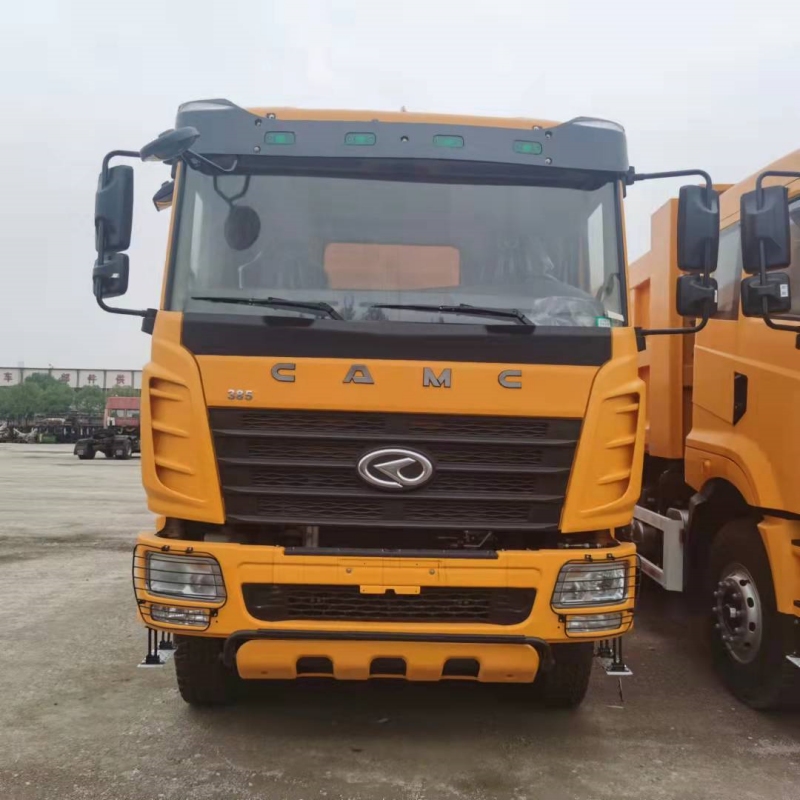
Aligning tread selection with specific vehicle architectures ensures optimal performance and prevents premature tire failure. Different truck configurations distribute weight and torque unevenly across their axles. Fleet managers must evaluate tread patterns based on how they interact with specific suspension setups, wheelbase lengths, and payload capacities. Matching the right tire to the right configuration scales operational efficiency across the entire fleet, reducing maintenance intervals and improving overall site safety.
The standard tandem drive setup of a 6x4 dump truck relies heavily on aggressive open-shoulder drive tires to maintain momentum. Because power is distributed across two rear axles, the tires must work in unison to push the vehicle through deep mud or loose gravel. Open-shoulder designs allow the outer edges of the contact patch to bite into soft terrain, providing the necessary lateral and forward traction. Selecting deep-tread lug patterns for these drive axles ensures the vehicle rarely loses forward momentum on challenging sites.
When operating a tandem drive setup, the inter-axle differential locks are frequently engaged to overcome slippery conditions. This mechanical locking forces both drive axles to spin at the same speed. If the tread patterns on these axles lack sufficient void space to clear mud, the tires will simply spin in place, polishing the ground into a slick surface. Equipping the rear axles with matching, high-traction lug tires prevents this scenario and maximizes the effectiveness of the differential locks.
Adding axles introduces mechanical complexities that directly impact tire wear. The heavier front-end weight distribution of an 8x4 dump truck requires steer tires engineered with reinforced ribs and specific tread depths. Twin-steer configurations subject the front tires to immense lateral scrubbing forces during tight site maneuvering. Without highly rigid tread blocks and optimized shoulder designs, these steer tires will quickly develop cupping and irregular wear patterns. Proper selection mitigates the aggressive wear caused by the unique steering geometry of four-axle setups.
The secondary steer axle on these heavy-duty configurations often bears a significant portion of the payload weight during cornering. Standard highway steer tires will fold under this pressure, causing the outer ribs to wear down prematurely. Specifying a steer tire with a wide, solid outer shoulder provides the necessary rigidity to withstand these lateral forces, extending the tire's usable life and maintaining precise steering control on uneven ground.
Establishing a definitive framework for axle positioning prevents dangerous handling characteristics. Rib or modified-rib designs belong exclusively on the steer axle to maintain precise directional control and resist lateral scrubbing. Deep-tread lug designs belong on the drive axles to provide the necessary propulsion and braking grip. Mixing these applications—such as placing aggressive lug tires on a steer axle—ruins steering precision, increases driver fatigue, and accelerates uneven wear across the entire contact patch.
Tire procurement inherently involves financial compromises between upfront expenses and long-term durability. Fleet managers must frame their purchasing decisions around overall value rather than simply hunting for the lowest initial cost. Factors influencing this value include fuel consumption rates, puncture resistance, casing durability, and the specific terrain of the primary job sites. Balancing these variables ensures the fleet operates efficiently without suffering from constant tire-related downtime.
To evaluate tire performance effectively, fleet managers should track the following metrics:
Average removal mileage per tire model.
Frequency of puncture-related downtime events.
Percentage of casings accepted for retreading.
Fuel consumption variations between different tread patterns.
Aggressive off-road treads carry a significant rolling resistance penalty on paved surfaces. Deep voids and blocky lugs require more engine power to maintain highway speeds, directly increasing fuel consumption. Operators must calculate whether the fuel penalty incurred on paved transit routes is offset by the reduction in site-level downtime. If a vehicle spends 80% of its time in deep mud, the off-road grip easily justifies the fuel penalty. If the vehicle mostly runs on packed dirt and asphalt, a less aggressive tread provides better overall value.
Evaluating lifecycle cost provides a clear picture of true tire value. A premium tire featuring a specialized rough-site tread often requires a higher initial investment. However, this specialized rubber compound and optimized geometry routinely deliver significantly more removal mileage before wearing down to the legal limit. Tracking removal mileage proves that investing in high-quality, application-specific tires yields a much better return on investment by drastically extending the time between replacement cycles.
The ultimate value of a commercial tire lies in its casing. High-quality tread designs incorporate stone ejectors—small raised elements at the base of the grooves—that prevent rocks from wedging into the tread. Without these ejectors, trapped stones slowly drill down into the steel belts, destroying the casing. Protecting the casing from rock drilling preserves its structural integrity, allowing the fleet to retread the tire multiple times. This capability significantly lowers long-term operational costs.
Fleet managers frequently make critical errors when specifying tires for rough sites, leading to rapid wear and mechanical failures. Mitigating these risks requires strict adherence to application guidelines and a deep understanding of site conditions. Relying on outdated procurement habits or prioritizing cheap replacements over correct specifications exposes the fleet to unnecessary downtime. Establishing rigid tire selection protocols prevents these common implementation failures.
Mixing incompatible tread depths or patterns on tandem drive axles causes severe mechanical strain. Different tread depths result in slightly different overall tire diameters. When mismatched tires operate on a connected tandem axle, the size difference causes differential wind-up, forcing the drivetrain to absorb massive rotational stress. This mismatching destroys power dividers, accelerates irregular tire wear, and compromises the vehicle's ability to maintain traction on slippery surfaces.
Adopting a "one size fits all" approach to tire procurement guarantees sub-optimal performance. The tread requirements of a wet, clay-heavy excavation site differ entirely from those of a dry, sharp-rock quarry. Clay demands high-void, open-shoulder designs for self-cleaning, while sharp rocks require closed-shoulder, low-void designs made from cut-resistant compounds. Ignoring these site-specific variables results in rapid tread chunking in quarries or total immobilization in muddy excavations.
Selecting highly aggressive, low-speed treads for vehicles that spend the majority of their duty cycle on high-speed wet highways introduces significant operational risks. Deep lug tires generate excessive heat buildup during sustained highway speeds, leading to accelerated wear and potential tread separation. Furthermore, aggressive mud treads often suffer from reduced wet-braking performance on asphalt. Operators must accurately assess the ratio of on-road to off-road driving to select a tread that handles the transition zone safely.
Rough-site treads demand aggressive maintenance protocols to survive their intended lifecycle. These specialized tires are highly susceptible to rapid, irregular wear if run underinflated or misaligned. Heavy loads and rough terrain amplify the damage caused by improper inflation pressures. Fleet maintenance teams must conduct frequent pressure monitoring and routine alignment checks to ensure the tread blocks wear evenly and the casing remains protected from excessive flexing and heat generation.
A robust maintenance program should include:
Weekly cold inflation pressure checks using calibrated gauges.
Visual inspections for tread chunking, sidewall cuts, and trapped stones.
Scheduled axle alignments every 50,000 miles or after severe off-road impacts.
Regular rotation of drive tires to equalize wear patterns across the tandem setup.
Dump truck performance on rough sites remains strictly bound by the physical limitations and design intent of the tire tread. No amount of horsepower or driver skill can overcome the physics of a poorly matched tire spinning helplessly in deep mud or tearing apart on jagged rocks. Selecting the correct tread geometry, compound, and axle position ensures the vehicle maintains traction, stability, and operational efficiency across the harshest environments.
Effective procurement relies on a sequential shortlisting logic. First, audit the primary site terrain to determine the necessary void ratio and compound hardness. Second, match the tread pattern to the specific axle and truck configuration, accounting for the unique demands of multi-axle setups. Third, factor in the ratio of on-road to off-road driving to balance grip with rolling resistance. Finally, calculate the projected lifecycle cost based on expected removal mileage and casing retreadability.
To optimize your fleet's tire performance, take the following actions:
Conduct a scrap tire analysis to identify primary failure modes like rock drilling or shoulder tearing.
Audit your current job sites to classify the dominant terrain type (mud, rock, or mixed).
Standardize tread specifications for steer and drive axles based on your specific truck configurations.
Implement a strict weekly tire pressure monitoring program to protect casing integrity.
A: High-void, open-shoulder lug patterns perform best in deep mud. These designs feature wide gaps between the tread blocks, allowing centrifugal force to eject mud and clay as the tire rotates. This self-cleaning action prevents the tire from packing with debris and losing traction.
A: No. Distinct steer and drive patterns are necessary for safety and wear prevention. The steer axles require rib patterns for precise directional control and lateral stability, while the drive axles require aggressive lug patterns to provide forward propulsion and braking traction under heavy loads.
A: The void ratio determines how much open space exists in the tread. Higher void ratios with wide, deep channels effectively evacuate standing water away from the contact patch. This prevents water from building up under the rubber, significantly reducing the risk of hydroplaning on wet asphalt.
A: Closed-shoulder tires feature continuous outer ribs that provide excellent lateral stability, longer highway wear, and resistance to rock damage. Open-shoulder tires feature gaps on the outer edges, providing superior bite and self-cleaning capabilities for off-road mud and snow traction.
A: Uneven wear typically results from mechanical misalignment, improper inflation pressures for the hauled load, or using mismatched tread compounds for the specific terrain. Tight maneuvering on high-friction surfaces also causes lateral scrubbing, which rapidly degrades the tread blocks if the suspension is not perfectly aligned.


