 English

Views: 0 Author: Site Editor Publish Time: 2026-07-29 Origin: Site


Specifying the wheelbase on a commercial chassis is a permanent decision that dictates the operational ceiling, safety profile, and driver satisfaction of your entire fleet. Once the frame rails are drilled and the crossmembers bolted at the factory, the physical geometry of the rig is locked in. This single dimension fundamentally controls how the vehicle interacts with the road surface, the trailer kingpin, and the loading dock.
Mismatching the wheelbase to your actual route realities creates costly daily friction. An overly long chassis guarantees dock-access failures in tight urban environments, forcing drivers into dangerous blind-side backs or causing property damage. Conversely, an excessively short chassis accelerates driver fatigue through brutal ride quality and complicates axle weight compliance on long-haul routes. Fleet managers must evaluate these dimensions carefully before signing off on a build sheet.
To make the right equipment choice, operators need a technical framework for evaluating wheelbase dimensions. Balancing the physics of longitudinal stability against the spatial requirements of maneuverability ensures the selected tractor truck performs safely and efficiently within its intended application.
Stability vs. Agility: Longer wheelbases inherently reduce pitching motion and improve highway tracking, whereas shorter wheelbases drastically reduce turning radius for tight-yard navigation.
Scaling and Compliance: Wheelbase length directly impacts bridge law compliance and the ability to legally distribute payload weight across steer and drive axles.
Application-Driven Spec'ing: Over-the-Road (OTR) and heavy-haul operations demand longer wheelbases for ride quality; regional, LTL, and urban operations require shorter wheelbases for dock accessibility.
In commercial trucking, wheelbase is not a rough estimate. It is a precise mathematical value that dictates the entire steering and suspension geometry. You measure it as the exact distance from the center of the steer axle hub to the center of the drive axle. For multi-axle configurations, the measurement extends from the steer axle center to the exact center point between the tandem drive axles, commonly referred to as the trunnion.
To measure this accurately in the yard, follow these steps:
Park the vehicle on flat, level ground with the steer tires perfectly straight.
Locate the exact center of the front steer axle hub.
Run a tape measure straight back along the frame rail.
For a single drive axle, measure to the center of the rear hub. For a tandem drive, measure to the center point between the two rear hubs.
You must distinguish wheelbase from the Bumper-to-Back-of-Cab (BBC) dimension. BBC measures the cab footprint, while wheelbase dictates the structural pivot points. A truck can feature a short 112-inch BBC day cab but sit on a long 240-inch wheelbase. Together, these measurements dictate the physical footprint and the turning radius based on Ackermann steering geometry. This geometry calculates the specific angles required for the inside and outside steer tires to navigate a curve without dragging or scrubbing the tread.
The distance between axles directly influences longitudinal stability. A longer span mitigates the lever-effect exerted by heavy trailers pushing against the fifth wheel. When a loaded 53-foot trailer shifts its weight over uneven terrain, the extended frame absorbs and distributes that kinetic force over a wider area. This keeps the steer tires firmly planted on the pavement, maintaining steering authority.
Wheelbase also dictates the transfer of kinetic energy during hard braking and acceleration. Under heavy braking, the vehicle's mass transfers violently to the front axle. A longer chassis slows this weight transfer, preventing the rear drive axles from lifting or losing traction. This stability is critical when hauling liquid surges in smooth-bore tankers or unsecured flatbed freight. A short wheelbase reacts much faster to these forces, making the vehicle feel twitchy and less planted during emergency maneuvers.
Backing a trailer into a tight space relies entirely on pivot physics. The drive axles act as the fulcrum point. Shorter wheelbases react instantly to steering inputs because the steer tires have less distance to travel to change the angle of that fulcrum. A slight turn of the steering wheel translates immediately to the fifth wheel, pushing the trailer aggressively. This rapid response is highly efficient for skilled drivers spotting trailers in tight intermodal yards, but it carries a higher risk of oversteering.
A long-wheelbase setup exhibits slower, more predictable trailer reaction times. The driver must apply steering input earlier and hold it longer to articulate the trailer. The distinct disadvantage here is the wider front-end nose swing. As the rear of the truck pivots to push the trailer, the front bumper swings out significantly in the opposite direction. Drivers require massive clearance in front of the vehicle during reverse maneuvers to avoid clipping fences, parked cars, or other trucks.
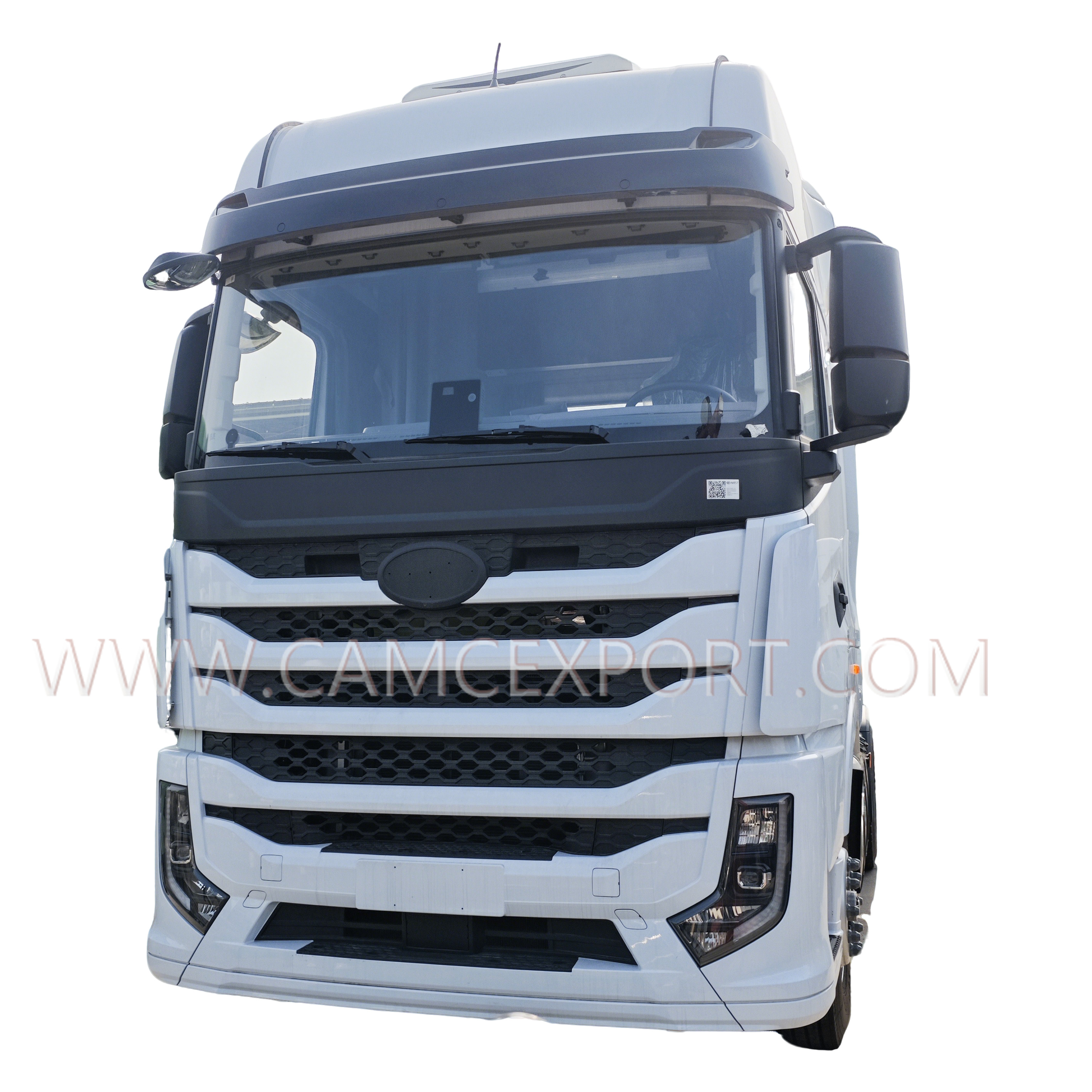
A long chassis acts as a mechanical dampener against road imperfections. Highway expansion joints, bridge transitions, and potholes send violent shockwaves through the frame rails. The extended distance between the steer and drive axles dissipates these forces before they reach the cab mounts. This drastically reduces the "porpoising" or pitching motion common at highway speeds, especially when pulling poorly loaded trailers.
Ride smoothness directly correlates with driver retention and safety. In over-the-road applications, operators spend up to eleven hours a day in the seat. Reducing the physical pounding of a rough ride minimizes spinal fatigue, joint pain, and mental exhaustion. For cross-country operations running coast-to-coast, specifying a wheelbase over 230 inches is a standard practice purely for the ergonomic benefits it provides to the operator.
A longer frame provides the necessary physical space to slide the fifth wheel forward or backward along its track. This adjustability allows operators to shift payload weight toward the steer axle legally, preventing drive axle overloads. If you pick up a nose-heavy load, you slide the fifth wheel back. If your drives are heavy, you slide it forward. You need adequate frame rail length behind the cab to make these adjustments without the trailer nose hitting the sleeper.
When operating a 6x4 tractor truck, a long wheelbase creates synergy with the Federal Bridge Gross Weight Formula. Bridge laws dictate that weight must be spread over a specific distance to prevent infrastructure damage. The formula calculates allowable weight based on the distance between the extremes of any group of axles. A longer chassis increases this distance, allowing the vehicle to legally scale heavier payloads.
Extra chassis length also provides frame rail versatility. A single extended truck can adapt to diverse trailer profiles. An operator can pull a standard dry van on Monday, and switch to a specialized multi-axle lowboy on Tuesday. The long frame provides the necessary swing clearance for different kingpin settings without violating weight distribution regulations.
Classic long-hood models often feature wheelbases exceeding 260 inches, sometimes stretching past 280 inches for custom builds. While these trucks offer superior ride quality and traditional styling, they introduce severe operational constraints. The extended hood length pushes the steer axle further forward, fundamentally altering the driver's forward visibility.
The combination of an extended hood, a low-riding cab, and a massive wheelbase compounds blind spots. Drivers lose sight of smaller vehicles directly in front of the bumper. Furthermore, operators must account for significant bumper-to-bumper clearance requirements. Pulling up to a standard fuel island, navigating tight intersections, or changing lanes in heavy traffic requires constant spatial awareness. The truck simply takes up more physical real estate on the pavement.
The primary drawback of an extended frame is the mathematical increase in swept path and turning radius. The turning radius is the radius of the smallest circular turn the vehicle can make. A truck with a 265-inch wheelbase requires significantly more pavement to complete a 90-degree right-hand turn than one with a 210-inch wheelbase. The trailer tracks further inside the turn, increasing the risk of clipping curbs or street signs.
Navigating older distribution centers, tight truck stops, and dense urban environments becomes a daily source of operational friction. Many industrial parks built in the 1970s and 1980s were designed for cabover trucks pulling 40-foot trailers. Sending a modern conventional sleeper with a 250-inch wheelbase into these facilities guarantees operational failure. Drivers often find themselves trapped in yards, requiring multiple pull-ups to hit a dock, which leads to delayed deliveries and increased accident risks.
Shorter wheelbases drastically reduce the turning radius, allowing the vehicle to snake through congested areas with ease. The ability to back into restricted-clearance loading docks without requiring multiple pull-ups is a massive operational advantage in city limits. When a driver can hit a dock on the first try, turnaround times decrease, and daily productivity increases.
This agility translates to direct operational efficiency in pickup and delivery (P&D), intermodal drayage, and regional hauling. Drivers can navigate active construction zones, municipal job sites, and crowded bulk terminal facilities with precision. In applications where the truck rarely exceeds 55 mph and spends most of its day navigating surface streets, a wheelbase under 200 inches is highly advantageous.
The maneuverability of a short chassis comes at the direct cost of longitudinal stability. These vehicles are highly sensitive to steering inputs at high speeds. A sudden lane change, a blown steer tire, or an evasive maneuver on the interstate can quickly unsettle the trailer. Because the distance between the steer and drive axles is short, the trailer has more leverage to push the rear of the truck.
In adverse weather conditions, such as snow or heavy rain, this sensitivity increases the susceptibility to jackknifing. If the drive tires lose traction, the trailer's forward momentum will easily push the short chassis sideways. Furthermore, the proximity of the fifth wheel to the cab transfers trailer shocks directly into the driver's seat. Every bump the trailer hits is felt immediately in the cab, resulting in a noticeably harsher ride quality.
A short chassis severely limits the physical real estate available on the frame rails. Packaging essential components becomes a complex engineering challenge. You only have a set number of inches between the back of the steer tire and the front of the drive tires. Operators must carefully evaluate the placement of every component.
| Component | Average Frame Space Required | Impact on Short Wheelbase |
|---|---|---|
| 100-Gallon Fuel Tank | 45 - 50 inches | May require downsizing to 70-gallon tanks. |
| Diesel Exhaust Fluid (DEF) Tank | 25 - 30 inches | Fixed position near exhaust; limits fuel tank placement. |
| Auxiliary Power Unit (APU) | 28 - 32 inches | Often impossible to mount without extending wheelbase. |
| Battery Box / Air Tanks | 30 - 40 inches | Must be relocated under the cab or between frame rails. |
Often, fleets must sacrifice fuel capacity to achieve the desired wheelbase. Running smaller fuel tanks leads to more frequent fuel stops, altering route planning and reducing daily range. If you need a headache rack, an APU, and dual 120-gallon tanks, a short wheelbase simply will not provide the physical space required to mount them.
Procurement must begin with a rigorous audit of fleet routes. Managers should calculate the percentage of highway miles versus surface street miles. If a truck spends 80% of its time on the interstate hauling dry vans, a longer wheelbase is justified for the ride quality. If the route involves daily urban deliveries in older northeastern cities, a shorter frame is mandatory.
Evaluate the average age and size of customer loading docks. Use satellite mapping tools to measure the dock approach distance at your most frequent delivery points. If the distance from the dock face to the perimeter fence is less than 100 feet, a long-wheelbase sleeper pulling a 53-foot trailer will struggle to bump the dock without dropping the trailer or performing extreme maneuvers.
The density and type of freight dictate the necessity for specific wheelbase lengths. Hauling dense materials like flatbed steel, concrete barriers, or heavy machinery requires precise weight distribution to meet Department of Transportation scaling laws. A longer wheelbase allows the fifth wheel to be positioned optimally to shift weight to the steer axle, ensuring neither the drives nor the trailer axles exceed their legal limits.
Conversely, hauling lightweight consumer goods, insulation, or empty containers rarely challenges axle weight limits. These loads "cube out" before they "weigh out." In these scenarios, fleets can specify shorter, more maneuverable trucks without fear of scaling violations at the weigh station.
The length of the chassis directly impacts the driveline architecture of a diesel tractor truck. The driveshaft must transmit torque from the transmission output yoke to the forward drive axle. Longer wheelbases require multi-piece driveshafts with carrier bearings to span this extended distance safely without sagging or vibrating.
Multi-piece drivelines introduce additional maintenance points. Carrier bearings wear out, and the U-joints must be perfectly phased to prevent driveline vibrations at highway speeds. If the driveline angles are incorrect, it will destroy the transmission output seal and the differential input seal.
Shorter wheelbases utilize simpler, single-piece or short two-piece driveshafts. These are more robust and require less maintenance. However, if the suspension is raised for vocational clearance, the extreme driveline angles on a short chassis can accelerate U-joint wear. You must balance the wheelbase length with the suspension ride height to maintain optimal driveline geometry.
To optimize fleet performance based on wheelbase dimensions, take the following actions:
Audit your most frequent delivery locations using satellite imagery to determine the absolute maximum turning radius your trucks can safely navigate.
Analyze weigh station data to see if your current fleet struggles with steer axle weight compliance, indicating a need for longer frames and sliding fifth wheels.
Consult with drivers operating in both urban and OTR environments to identify where ride quality or maneuverability is causing daily friction.
Map out frame rail packaging requirements for fuel tanks, DEF tanks, and APUs in inches before committing to a short-wheelbase specification.
A: You measure the wheelbase by finding the exact center of the front steer axle hub and measuring straight back along the frame rail to the exact center point between the two rear drive axles. This center point between the drives is known as the trunnion.
A: Wheelbase directly dictates the turning radius. A longer wheelbase increases the distance between the pivot points, requiring a wider circle to complete a turn. A shorter wheelbase brings the axles closer together, allowing the vehicle to pivot sharper and complete turns in much tighter spaces.
A: While technically possible, stretching or shortening a truck's frame is highly complex and requires specialized engineering. It involves cutting the high-strength steel rails, modifying the driveline, and rerouting air lines and wiring harnesses. It compromises factory warranties and is always better to spec correctly upfront.
A: The Federal Bridge Formula calculates allowable vehicle weight based on the distance between axle groups. A longer wheelbase increases the distance between the steer and drive axles, spreading the vehicle's weight over a greater area. This allows the truck to legally carry heavier payloads without damaging highway infrastructure.
A: Heavy-haul trucks require long wheelbases to accommodate multiple auxiliary lift axles, such as pushers or tags. The extended length also provides the necessary leverage to keep the steer tires firmly planted on the ground when pulling massive, oversized loads that exert extreme downward force on the fifth wheel.


