 English


Views: 0 Author: Site Editor Publish Time: 2026-11-26 Origin: Site


Transitioning a yard fleet from diesel to electric fundamentally changes your daily operations. You shift the operational bottleneck from the vehicle's mechanics directly to its energy replenishment cycle. When deploying an electric terminal tractor, fleet operators face a critical dilemma. You must choose between plugging in vehicles during scheduled breaks or physically replacing depleted batteries with fully charged ones. The first method utilizes opportunity charging. The second relies entirely on battery swapping. Both approaches carry unique logistical demands. This guide provides logistics directors an evidence-based, vendor-agnostic framework. You will learn how to evaluate these two competing infrastructure models. We base this comparison heavily on shift intensity, yard throughput, and facility constraints. You will discover how to match your yard flow to the precise energy strategy you need. By the end, you will know exactly how to evaluate your site and maintain high operational efficiency.
Shift intensity dictates the model: Opportunity charging generally supports 1-to-2-shift operations, while battery swapping achieves the near-zero downtime required for 24/7, high-throughput ports and distribution centers.
CapEx vs. OpEx trade-offs: Swapping requires significantly higher upfront capital and standardized vehicle procurement, but can lower utility demand charges through slow, off-peak battery charging.
Grid constraints are the ultimate gatekeeper: Facilities with limited incoming power capability may find battery swapping’s localized energy storage buffer more feasible than installing multiple high-kilowatt DC fast chargers.
In terminal operations, a stationary truck actively harms the entire logistics chain. If a tractor dies mid-route, dock workers and crane operators sit idle. Diesel tractors boast a reliable five-minute refueling turnaround. Electric models must aim for strict parity in vehicle availability. They might not match the raw replenishment speed of a diesel pump. However, they must keep the freight moving smoothly. The cost of idle assets runs incredibly high.
A battery-powered fleet fundamentally changes your established yard flow. You cannot simply park vehicles anywhere anymore. Your route planning must now intersect directly with charging station placement. It must also align seamlessly with available grid capacity. Operators must redefine their operational baseline. Yard automation requires highly synchronized schedules. You must coordinate driver shifts, break times, and energy delivery perfectly.
Many fleet managers fall for the false dichotomy of range. For heavy-duty yard trucks, absolute battery capacity matters much less than smart charging integration. You should stop asking how far the truck can go on a single charge. Instead, focus entirely on replenishment efficiency. Ask yourself how fast you can put energy back into the vehicle. You must do this without disrupting scheduled shift changes. The uptime challenge requires precise orchestration rather than just buying bigger batteries.
Opportunity charging capitalizes on existing operational pauses. Vehicles connect to high-power DC fast chargers during mandatory driver breaks. They also plug in during shift changes or extended loading windows. These chargers typically deliver 50kW to 150kW of power. This strategy tops up the battery multiple times a day. It keeps the state of charge within a healthy operating window.
This model offers distinct operational advantages for lighter duty cycles. You face lower infrastructure footprints upfront. You only need standard DC fast charging pedestals. You avoid installing complex robotic swapping gantries. It also offers excellent hardware flexibility. Universal charging standards like the Combined Charging System (CCS) allow operators to mix brands. You can seamlessly match different tractor manufacturers and charger vendors. This keeps procurement highly competitive.
However, you must manage significant operational risks. Schedule fragility is a massive concern. Missed charging windows compound very quickly. If yard congestion delays a driver's break, they miss their top-up session. This quickly leads to dead vehicles mid-shift. Peak demand penalties also pose a serious threat. Utility companies often bill commercial facilities based on their highest 15-minute usage window. High-power charging during peak utility hours triggers severe demand charges. Constant rapid charging also accelerates battery degradation. High-voltage inputs combined with extreme outdoor operational temperatures severely reduce the overall battery lifecycle.
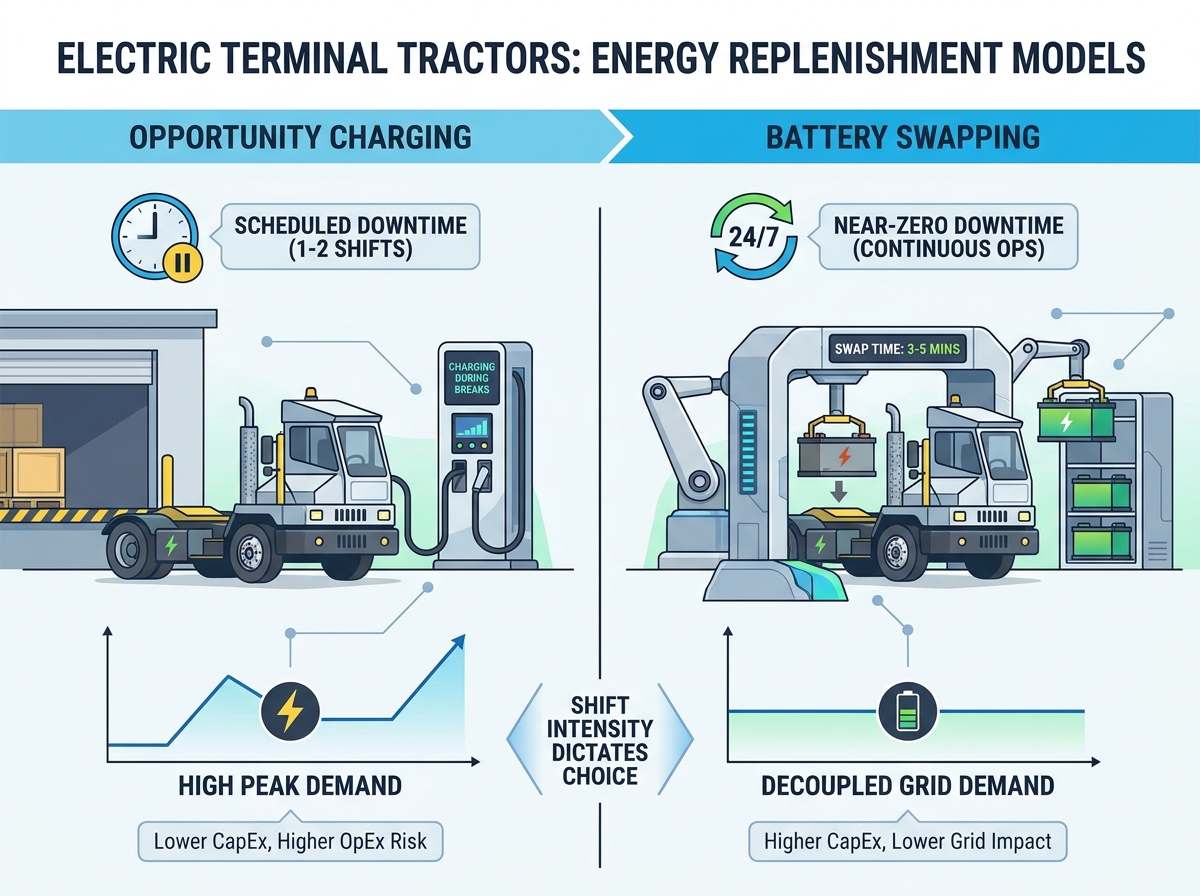
Battery swapping offers a completely different energy paradigm. A battery-swapping dock tractor pulls directly into a specialized station. An automated or semi-automated system physically removes the depleted pack. It then installs a fully charged battery in just three to five minutes. The driver barely leaves the cab. The vehicle returns to work almost immediately.
This approach delivers powerful operational advantages. You achieve true diesel-parity turnaround times. Swapping virtually eliminates charging downtime. It enables seamless three-shift, 24/7 utilization of the asset. You also decouple your fleet from peak grid demand entirely. Swap stations charge depleted batteries slowly and continuously in the background. This allows you to leverage cheap off-peak utility rates. You avoid expensive power demand spikes. Furthermore, this method greatly extends battery health. Slow, controlled charging in a climate-regulated rack preserves sensitive cell chemistry. It works far better than repetitive DC fast charging out in the harsh yard.
Despite these benefits, operational limitations exist. You face a massive infrastructure footprint. Swap stations require significant real estate to operate safely. They demand heavy structural engineering and substantial upfront investment. You also face strict vendor lock-in. Swapping mechanisms remain highly proprietary today. Committing to a swapping model binds you to a single manufacturer. You stay locked into their ecosystem for the entire lifespan of the infrastructure. Finally, you must account for battery inventory requirements. This model requires purchasing more than one battery pack per vehicle. You typically need a ratio of 1.2 to 1.5 packs per truck. This significantly increases initial procurement demands.
When planning your terminal tractor charging infrastructure, you must weigh specific facility metrics. We can break these down into three primary dimensions. You must analyze duty cycles, grid capacity, and physical space thoroughly.
You must map out hours of continuous operation versus guaranteed idle time. Track this closely over a standard 24-hour cycle using telematics. If guaranteed idle time drops below 20 percent of the shift, opportunity charging struggles. If a truck operates continuously with only fragmented five-minute gaps, plug-in charging fails. It becomes mathematically unviable unless you drastically expand the total fleet size. High throughput demands continuous power availability.
Grid capacity heavily influences your final decision. You need to compare existing site megawatt capacity against your required peak charging load. Local utility upgrades can often take 18 to 24 months to complete. Upgrading a site from a standard 2MW feed to a 5MW feed requires major trenching and substation approvals. If you face this delay, a battery swap station makes sense. It acts as a localized energy buffer. It draws lower, steady power over time. This helps you bypass immediate grid bottlenecks effectively.
Consider the square footage required for new infrastructure. You must also factor in vehicle turning radii. Opportunity chargers offer excellent spatial flexibility. You can distribute them across existing parking bays easily. They fit neatly on bollards or along perimeter fences. Swap stations demand dedicated, centralized drive-through lanes. These large structures may disrupt your established yard traffic patterns. They require extensive planning to avoid creating new operational bottlenecks.
Infrastructure Comparison Chart
| Decision Dimension | Opportunity Charging | Battery Swapping |
|---|---|---|
| Idle Time Requirement | Requires >20% guaranteed idle time per shift | Minimal (3-5 minute turnaround per swap) |
| Grid Impact | High peak load during active charging windows | Low, steady power draw (acts as energy buffer) |
| Space Utilization | Flexible distributed parking bays and fences | Large, centralized drive-through station footprint |
Deploying new infrastructure introduces distinct implementation hurdles. Managers often underestimate the change management process. Opportunity charging demands strict behavioral changes from your drivers. They face mandatory plug-ins during every single break. Compliance is absolutely critical. If one driver forgets to plug in, the next shift inherits a dead truck. Swapping requires a completely different approach. Your team needs specialized training for station operation. They must master new automated safety protocols and precise vehicle alignment.
Maintenance brings specific failure points for each model. Opportunity chargers face frequent physical abuse in active yards. You will see cable wear and connector damage from careless drops in the dirt. Software handshake failures between the truck and charger also disrupt schedules. Swap stations face distinct mechanical wear and tear. Robotic arms degrade over time. Alignment sensor calibration can drift under heavy usage. Moving parts remain constantly exposed to harsh yard environments and extreme weather.
You must also consider long-term future-proofing. The heavy-duty electric vehicle market is still consolidating rapidly. Investing heavily in proprietary swapping technology carries risks. You could face stranded assets down the line if the vendor pivots. The industry might soon standardize heavily on Megawatt Charging Systems (MCS). Keep this standardization timeline in mind when planning your long-term infrastructure roadmap.
You need a clear action plan. Use the following criteria to evaluate your operational fit. Different yards require vastly different approaches.
Your facility operates on one or two shifts daily.
You have highly predictable, mandatory downtime built into driver schedules.
You want to avoid vendor lock-in for future hardware purchases.
You plan to operate a mixed-OEM fleet over time.
Your site has ample, easily accessible grid power right now.
You can implement smart-charging software to mitigate peak demand spikes successfully.
You operate a relentless 24/7 port or high-velocity distribution center.
You know downtime directly equals immediate lost revenue for your business.
Your local utility cannot provide immediate megawatt capacity upgrades.
You cannot support simultaneous DC fast charging for the entire fleet.
You are willing to standardize strictly on a single vehicle brand.
You seek maximum asset utilization and extended battery lifespans above all else.
No universal best choice exists in yard electrification. The right infrastructure depends entirely on your specific duty cycles. Grid realities dictate what you can actually build and sustain. Opportunity charging suits highly predictable, lower-intensity environments perfectly. Battery swapping thrives in high-pressure, relentless operations where time literally equals money.
You must take actionable next steps today. Do not issue an RFP for vehicles immediately. First, conduct a comprehensive site energy audit. Review the telematics data of your current diesel fleet closely. Map out exact idle times. Calculate your precise energy requirements per shift. Let your raw operational data drive your final infrastructure choice.
A: Yes, most swap-capable tractors also feature standard CCS ports. This dual capability allows for flexible hybrid charging strategies. If a swap station goes offline for routine maintenance, drivers can temporarily rely on standard plug-in chargers. This keeps your yard operations moving without experiencing total fleet disruption.
A: A battery swap station typically requires the footprint of three to four standard trailer parking spots. It also needs ample drive-through clearance for safety. In contrast, you can mount DC fast charging dispensers neatly on existing bollards, fences, or compact islands between your standard parking bays.
A: Swapping hardware remains highly proprietary today. Because of this, the station and the vehicle usually come from the exact same manufacturer or certified partner network. This closed-loop system ensures warranties remain fully intact under standard, tightly controlled service and maintenance agreements.
A: MCS will drastically reduce traditional plug-in times for heavy vehicles. However, it requires massive grid capacity upgrades that are often cost-prohibitive or delayed. Battery swapping will likely remain highly relevant for grid-constrained sites that cannot secure enough raw power to run multiple megawatt chargers simultaneously.


