 English

Views: 0 Author: Site Editor Publish Time: 2026-06-09 Origin: Site


For fleet managers and owner-operators, asking how heavy a truck is isn't just general curiosity. It represents a critical calculation of operational profitability and strict legal compliance. Buying a chassis boasting a massive Gross Vehicle Weight Rating (GVWR) proves useless if the upfitted empty weight eats up your allowable payload. We call this empty weight the Tare Weight. Too many operators discover this reality too late. What a dump truck physically handles and what DOT regulations legally allow are often two completely different numbers. Ignoring this gap leads to devastating overweight fines or severe mechanical failures.
This comprehensive guide breaks down exact empty weights by axle class. You will clearly understand how hardware choices directly impact legal hauling limits. Finally, we provide a proven framework to maximize your payload capacity. You can haul more per trip without triggering any highway compliance issues.
Empty (Tare) Weight Variance: An empty commercial dump truck typically weighs between 16,000 lbs (light-duty) and 36,000+ lbs (tri-axle or multi-axle), depending on chassis and bed material.
The Golden Formula: Your true legal payload is always: Allowable GVWR minus the Actual Upfitted Tare Weight.
Material ROI: Spec’ing an aluminum dump body over steel can reduce empty weight by roughly 2,000 to 3,000 lbs, directly increasing legal payload capacity per trip.
Federal Compliance: Interstate weight limits are capped at 80,000 lbs, heavily dictated by the DOT Bridge Formula which factors in the number of axles and the distance between them.
Evaluating a truck's weight always starts at the foundation. You must examine the chassis and axle configuration. This structural base defines both the base weight and your operational footprint. Buyers cannot simply guess these numbers. You must know your baseline to calculate potential profit effectively.
Every axle adds significant mass. Every frame extension increases the gross mass. However, these mechanical additions also increase your legal hauling limits. We break down the most common configurations below.
An empty single-axle truck usually ranges between 16,000 and 20,000 lbs. Operators favor them heavily for residential projects and landscaping jobs. They offer an exceptionally short wheelbase. You can navigate tight urban streets easily. They carry less material but maneuver perfectly in small private driveways.
Tandem models step up the capacity significantly. Their empty weight ranges from 22,000 to 28,000 lbs. You see them performing standard construction hauling daily. They offer a shorter wheelbase than a tri-axle. This provides a much better turning radius on crowded job sites. However, they face stricter weight limits on federal highways.
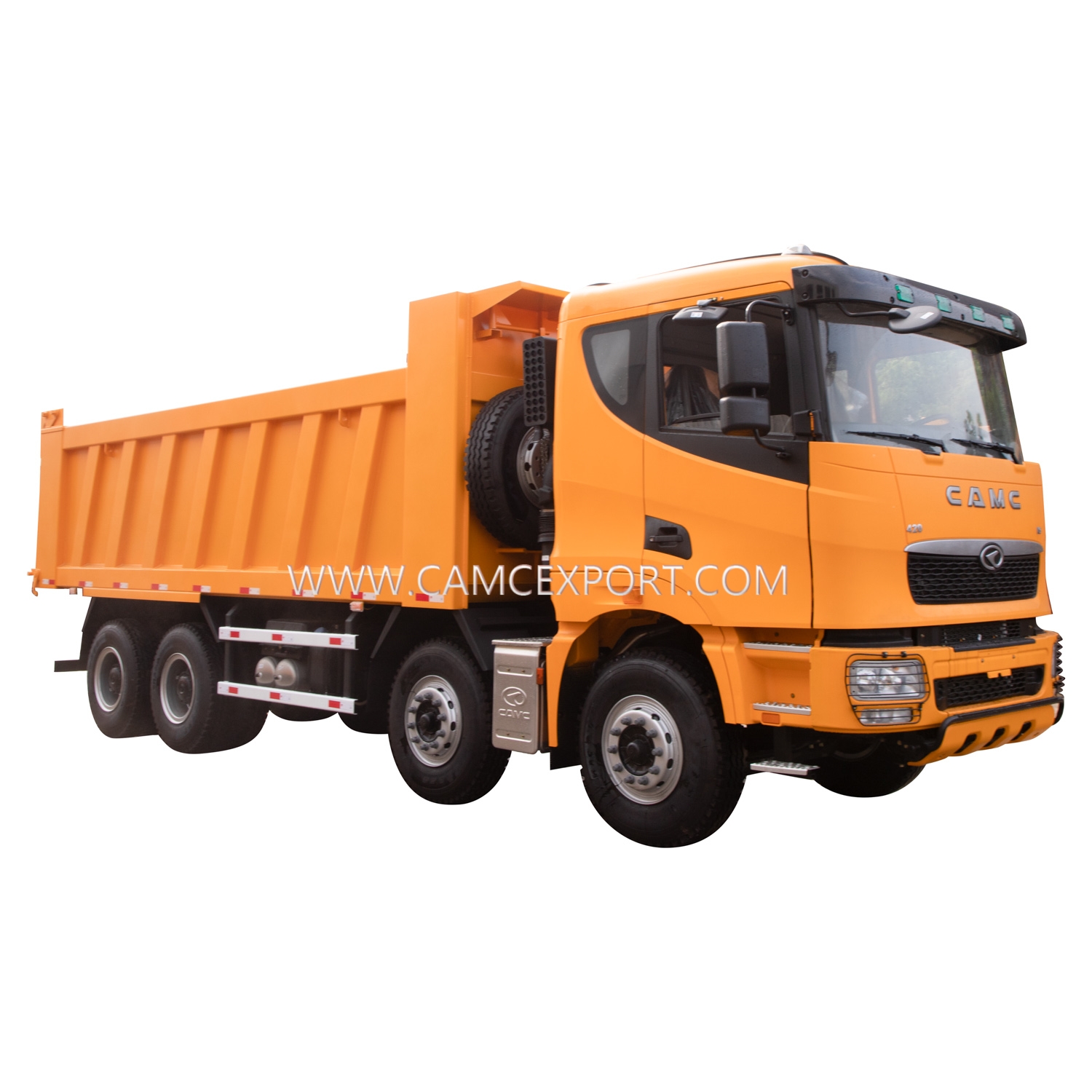
Heavy infrastructure demands tri-axle configurations. An empty tri-axle truck typically weighs between 25,000 and 35,000+ lbs. They dominate major paving and highway development projects. These trucks use specialized drop axles, also known as lift axles. The driver drops these extra wheels to distribute the load evenly across the pavement. This mechanical feature helps the truck comply strictly with DOT formulas.
Superdumps represent the absolute peak of rigid truck hauling. Their empty weight falls between 30,000 and 42,000 lbs. They utilize a highly specialized trailing axle. This axle drops down far behind the main chassis. It maximizes the wheelbase length significantly. You can legally haul payloads comparable to a massive semi-trailer. Many operators manage up to 26 tons of legal payload successfully.
| Axle Configuration | Empty Weight Range (lbs) | Primary Use Case | Maneuverability |
|---|---|---|---|
| Single-Axle (4x2) | 16,000 - 20,000 | Residential, Landscaping | Excellent |
| Tandem-Axle (6x4) | 22,000 - 28,000 | Standard Construction | Good |
| Tri-Axle / Multi (8x4+) | 25,000 - 35,000+ | Heavy Infrastructure, Paving | Fair |
| Superdump | 30,000 - 42,000 | Maximum Highway Payload | Poor (Requires wide turns) |
Many operators fall into a dangerous industry trap. They assume a commercial truck rated at 66,000 lbs GVWR automatically hauls 20 or more tons. This ignores the real-world weight of the custom upfit. You cannot simply haul your GVWR. You must understand the terminology properly to remain legal.
Gross Vehicle Weight Rating (GVWR): This specifies the absolute maximum safe weight. The manufacturer sets this hard limit permanently. It includes the chassis, the bed, all operating fluids, the driver, and your loaded cargo. Exceeding it causes catastrophic brake failure or frame cracking.
Gross Axle Weight Rating (GAWR): This defines the maximum allowable weight on individual axles. A truck can sit well under its total GVWR but still fail a state inspection. If a single axle exceeds its specific GAWR, you receive a costly citation. Poor load distribution causes this issue frequently. You must instruct loader operators to distribute materials evenly across the entire bed.
Common Mistake: Never trust the door sticker for your daily payload math. The sticker only shows theoretical limits.
The weigh station provides the only true reality check. The only accurate way to determine legal payload requires a certified scale. You must drive the fully upfitted, fully fueled truck onto the scale platform. Record this actual Tare Weight. Subtract this exact number from your legal GVWR. The remaining number reveals your true, legal payload limit. If you add heavy steel plating later, you must weigh the vehicle again.
Tonnage isn't just about physical bed capacity. It evaluates critical physical infrastructure limits. State and federal agencies strictly protect their expensive roads and bridges from rapid deterioration.
Commercial vehicles operating on the Interstate Highway System face strict federal limits. Federal laws cap their gross weight at exactly 80,000 lbs. You cannot exceed this cap on federal roads without securing special oversize permits.
The DOT Bridge Formula dictates everything you do on the highway. The DOT calculates legal limits based on two critical factors. First, they count the exact number of axles. Second, they measure the physical distance between the extreme ends of any axle group. A longer wheelbase spreads the crushing weight out over a much larger bridge surface. This allows for higher legal gross weights safely. Conversely, a short, stubby truck carrying heavy material damages bridges quickly. The DOT fines short, heavy trucks aggressively.
| Compliance Factor | Impact on Legal Weight | DOT Logic |
|---|---|---|
| More Axles | Increases allowable weight | Distributes pressure across more tire contact patches. |
| Longer Wheelbase | Increases allowable weight | Prevents concentrated stress on short bridge spans. |
| Lift Axle Raised | Decreases allowable weight | Concentrates weight on fewer active axles during transit. |
You must also understand distinct state-level variations. Interstate rules act as a national baseline. However, local hauling operates exclusively under individual state laws. Some states offer generous exemptions for specific commodities like agricultural goods or timber.
For example, Michigan allows specialized multi-axle configurations weighing up to an astonishing 164,000 lbs. Always consult your local DOT regulations before finalizing any fleet procurement. Local laws dictate your daily operational capacity and long-term revenue potential.
Purchasing decisions permanently alter the empty weight of your truck. These hardware choices directly impact your lifetime return on investment. Heavy hardware safely reduces maintenance but instantly steals payload capacity. Lighter hardware increases payload but introduces durability risks.
Steel remains the dominant industry standard. High-tensile steel, like AR-450, resists massive impacts brilliantly. It adds significant empty weight to your bare chassis. However, it is absolutely mandatory for highly abrasive materials. You need thick steel for hauling riprap, large demolition debris, and heavy boulders safely.
Aluminum offers a highly profitable alternative. An aluminum body weighs roughly 2,000 to 3,000 lbs less than a steel equivalent. This massive weight savings allows an additional 1 to 1.5 tons of legal payload per single trip. Over a busy year, this generates immense extra revenue for the owner.
Implementation Risk: Aluminum carries a significantly higher upfront purchase cost. It also requires highly specialized welding for future repairs. Large, abrasive rocks easily dent or tear aluminum sidewalls. You should reserve aluminum bodies strictly for sand, asphalt, and fine gravel operations.
Traditional square beds feature numerous heavy steel cross-members underneath the floor. These provide lateral stability. Half-round bodies eliminate the need for these heavy cross-members entirely. The natural curved design provides inherent structural strength.
This design lowers the truck's overall weight drastically. It also lowers the center of gravity significantly. A lower center of gravity reduces dangerous tipping risks during unloading operations. Furthermore, wet material slides out of a half-round bed easier. You carry less stuck material back to the quarry.
Every single accessory steals payload capacity. Consider the following common additions:
Heavy-duty hydraulic hoists add major metallic weight.
Automated tarp systems require heavy electric motors and steel arms.
Thick plastic or steel bed liners increase the tare weight substantially.
Extended thick asphalt aprons add steel mass strictly to the rear.
These common accessories can easily add 800 to 1,500 lbs to your total Tare Weight. They directly reduce your daily revenue-generating payload. Choose them carefully based on absolute operational necessity.
A common operational failure plagues the hauling industry. Inexperienced drivers load a truck based on volumetric capacity. They look solely at cubic yards rather than actual material weight. This leads directly to severe structural overloading. Overloading destroys commercial transmissions and snaps heavy suspension components routinely.
The density variable changes everything daily. Fifteen cubic yards of dry soil weighs significantly less than fifteen cubic yards of wet sand. Rainwater adds massive, hidden weight to any exposed load. If you ignore moisture content, you risk catastrophic failure.
Consider these typical density benchmarks to understand the severity:
Hot Mix Asphalt: Weighs approximately 2 tons per cubic yard.
Standard Gravel: Weighs roughly 2,700 to 2,800 lbs per cubic yard.
Dry Topsoil: Weighs about 2,000 lbs per cubic yard.
Wet Sand: Can exceed 3,000 lbs per cubic yard easily after rain.
If you possess a 15-yard bed and fill it completely with wet sand, you haul 45,000 lbs of material. Most standard tri-axles cannot legally haul 22.5 tons without specific state-level permits. The physical bed holds the volume perfectly, but the axles cannot legally support the mass.
We recommend following these strict operator best practices:
Match the bed's cubic yard capacity tightly to your most common material density.
Never buy a physical bed larger than your chassis can legally support when full.
Train loader operators to visually judge material weight, not just spatial volume.
Install digital onboard scale systems to monitor live axle weights during loading.
Determining how heavy a dump truck is requires moving entirely past basic averages. It represents an exact mathematical calculation. You must successfully balance Tare Weight, GVWR, and complex axle configurations against strict state bridge laws. A slight miscalculation results in heavy fines or broken equipment.
Take immediate action during your final decision stage. Before purchasing any new or used vehicle, demand scale tickets. You need the actual empty weight verified. Calculate the exact legal payload based on your specific local DOT regulations. Run a revenue analysis comparing aluminum versus steel bodies. Base this choice strictly on the specific abrasive nature of the materials your fleet hauls. Smart math prevents compliance fines and maximizes daily route profit.
A: Depending on the truck class and axle configuration, a fully loaded standard commercial dump truck typically weighs between 36,000 lbs (Class 7) and 80,000 lbs (Class 8 Federal Limit), though state-specific permits can allow higher limits.
A: Assuming a Tare Weight of roughly 25,000 to 28,000 lbs and a state limit of 70,000 to 80,000 lbs, a tri-axle can legally haul between 21 and 26 tons.
A: No. Adding aftermarket suspension parts or thicker steel plates increases your Tare Weight and reduces your available payload, but it does not legally increase the manufacturer-assigned GVWR on the chassis tag.


