 English


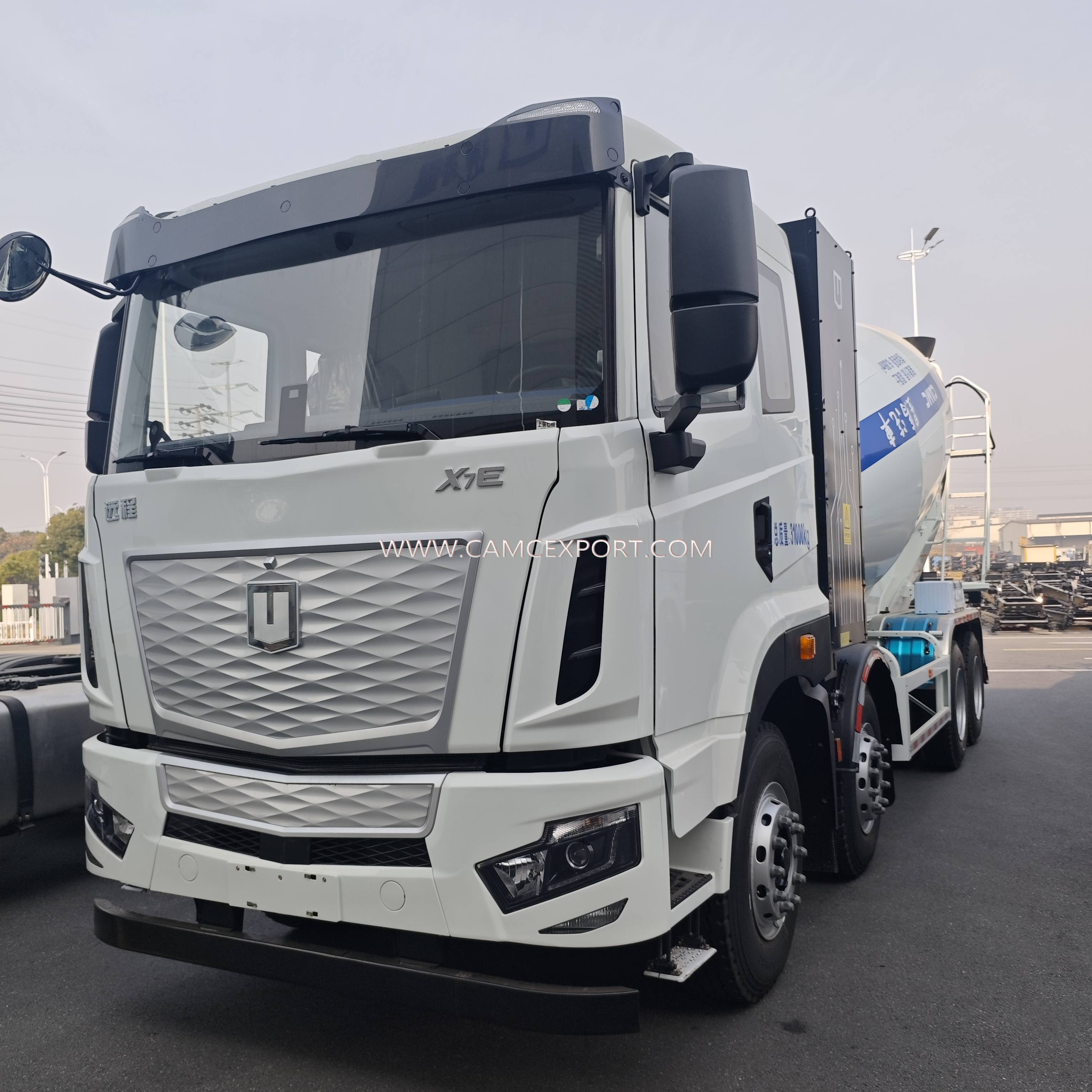
The 8x4 Left-Hand Drive Electric Concrete Mixer Truck (6-14m³) is an eco-friendly operation equipment tailored for modern low-carbon projects. Adopting a pure electric drive design, it completely eliminates exhaust emissions, perfectly meeting the strict environmental requirements of urban and industrial construction projects. Equipped with a 6-14m³ large-capacity mixing drum, the vehicle adapts to different engineering volume needs. The 8x4 drive form endows it with strong off-road passability and load-bearing capacity, and the left-hand drive layout conforms to the driving habits in most regions around the world. With its efficient mixing system, low-energy operation advantages and stable core performance, it has become the preferred mixing equipment for road and bridge construction, real estate development, municipal engineering and other scenarios, helping projects achieve the dual goals of green construction and cost reduction and efficiency improvement.
| Quantity: | |
|---|---|


X7E
CAMC
The CAMC X7E 8x4 left wheel drive electric concrete mixer truck is a zero emission and environmentally friendly construction equipment specially designed for modern low-carbon engineering projects. It focuses on diverse engineering scenarios such as municipal construction, real estate development, and road and bridge construction, helping global infrastructure projects achieve dual operational goals of green construction and cost reduction and efficiency improvement. The whole vehicle adopts a pure electric drive design, with no exhaust emissions throughout the process, perfectly meeting the strict environmental compliance requirements of cities and industrial construction in various countries, and adapting to the global trend of low-carbon infrastructure development. The vehicle is equipped with a 6-14m ³ large-span mixing bucket, which can flexibly adapt to the construction needs of different scales of projects and has strong universality; Relying on the mature 8x4 drive form, it has excellent heavy-duty bearing capacity and off-road performance, and can easily cope with unpaved roads and complex undulating road conditions on construction sites, with stronger adaptability. The vehicle adopts a globally recognized left-hand drive layout, which conforms to the driving habits and traffic regulations of the vast majority of countries and regions, and has a high degree of adaptability to sea travel. Paired with an efficient and stable professional mixing system, it achieves the core advantages of uniform concrete mixing, low material residue rate, and high operational efficiency. At the same time, relying on the low energy consumption characteristics of pure electric operation and the stable and reliable core performance of the three electric systems, it significantly reduces construction and operation costs. With excellent environmental protection properties, load-bearing capacity, and operational efficiency, it has become the preferred green mixing equipment for municipal engineering and infrastructure projects worldwide.
1. Pre-start Inspection
① Check if the battery power is sufficient and the charging interface is intact to ensure stable power supply; ② Check if the mixing drum, feed inlet and discharge outlet are clean and free of residues, and if the blades are tight and undamaged; ③ Check if the oil levels of the hydraulic system, braking system and steering system are normal and if there is any leakage; ④ Check the tire pressure, wear condition and the tightness of the hub bolts; ⑤ Enter the cab, adjust the seat and rearview mirror, and confirm that all indicator lights on the operation panel are normal.
2. Start-up and Operation
① Insert the key or press the start button to start the vehicle power system and wait for the system self-inspection to complete; ② Shift into the appropriate gear, release the handbrake, slowly step on the accelerator pedal, and start the vehicle smoothly; ③ After arriving at the loading location, stop the vehicle and pull the handbrake, operate the mixing drum control switch, adjust the mixing drum speed to the loading mode, and start loading; ④ After loading, adjust the mixing drum to the mixing mode and keep low-speed mixing to avoid concrete segregation; ⑤ During driving, pay attention to observing the road conditions, abide by traffic rules, avoid sudden acceleration and sudden braking, and monitor the operation status of the mixing drum at the same time.
3. Unloading Operation
① After arriving at the unloading location, stop the vehicle smoothly, pull the handbrake, adjust the vehicle position to align the discharge outlet with the receiving equipment; ② Operate the control switch, adjust the mixing drum to the unloading mode, and control the unloading speed; ③ During the unloading process, observe the concrete discharge status. If segregation or caking occurs, the mixing speed can be appropriately adjusted; ④ After unloading, operate the mixing drum to reverse, clean the residual concrete in the drum, and add water to rinse if necessary; ⑤ Turn off the mixing drum, confirm that there is no residue at the discharge outlet, then sort out the equipment and prepare for the next operation.
4. Shutdown and Maintenance
① After the operation is completed, park the vehicle in a flat and safe area, pull the handbrake, and turn off the power; ② Thoroughly clean the residual concrete in the mixing drum, feed inlet and discharge outlet to avoid solidification and caking; ③ Check the oil and power of each system, and if the power is insufficient, connect the charging equipment to charge in time; ④ Check if the vehicle appearance, tires, blades and other components are damaged, and repair them in time if there is any problem; ⑤ Complete the operation record, including operation time, project volume, equipment operation status, etc.
1. Zero carbon pure electric drive, strong compliance: adopting a new pure electric power design, zero exhaust emissions throughout the process, perfectly meeting the environmental standards of cities and industrial infrastructure in various countries, and adapting to global low-carbon and green construction policies.
2. Flexible volume and full coverage of working conditions: Supports 6-14m ³ multi level mixing volume, can freely match the needs of large and small engineering projects, and one equipment can adapt to multiple construction scenarios, with higher utilization rate.
3. Heavy duty stable driving, all road adaptability: The 8x4 drive structure endows the vehicle with super strong load-bearing capacity and off-road performance, making it stable and excellent in the face of complex and harsh road conditions on construction sites.
4. Global applicability and sea adaptation: The left-hand drive layout conforms to the driving habits and traffic regulations of most countries around the world, and can be adapted to overseas markets without modification, ready to use upon landing.
5. Efficient and low consumption, cost reduction and efficiency improvement: A professional and efficient mixing system ensures uniform and low residue concrete mixing, resulting in excellent construction quality; The pure electric low-energy operation mode significantly reduces project operating costs in the long run.

1. Southeast Asian municipal engineering contractor: “The local municipal construction environmental protection audit is strict, and the zero emission design of CAMC X7E 8x4 electric mixer truck fully meets environmental requirements, so there is no need to worry about policy restrictions. The 6-14 square meter capacity can adapt to our construction projects of different sizes. The 8x4 chassis has solid load-bearing capacity, stable traffic on rough roads, easy left-hand drive operation, low energy consumption and low noise in pure electric operation, effectively saving project construction costs. It is the main equipment for our municipal green construction. ”
2. South American infrastructure procurement operator: “We undertake road, bridge, and real estate infrastructure projects all year round. This electric mixer truck has outstanding comprehensive advantages, with uniform mixing effect, less material waste, high operating efficiency, and strong adaptability to complex construction site road conditions. The vehicle performance is stable, the failure rate is low, and the operation and maintenance cost is lower than that of fuel vehicles. The green construction attribute also helps our projects to better comply with regulations, making it very suitable for long-term overseas infrastructure use. ”
CAMC International is a benchmark enterprise in China's heavy vehicle manufacturing industry. As a key national supported research and development production base for heavy vehicles and components, the company has maintained a leading position in the industry since its establishment in the 1970s. With a complete layout of the entire industry chain, CAMC has become the only truck manufacturer in China with the ability to independently produce core components such as engines, transmissions, axles, chassis, and cab, achieving full process autonomy and controllability from key components to the entire vehicle.
The company relies on the research and development strength of the national enterprise technology center, and its products cover a full range of commercial vehicles such as heavy-duty trucks, engineering dump trucks, and special transport vehicles, which are widely used in key areas of the national economy such as infrastructure, mining, and logistics. Through continuous technological innovation and intelligent manufacturing upgrading, CAMC not only maintains a leading position in the domestic market, but also sells its products to more than 80 countries and regions around the world, especially in the markets along the "the Belt and Road". As a representative enterprise of high-end equipment manufacturing in China, the company is actively promoting the application of new energy and intelligent technology in the commercial vehicle field, leading the industry to transform and upgrade towards green and low-carbon direction.

Q: What is the driving range of this truck?
A:Our trucks have been tested for millions of kilometers before leaving the factory. Please refer to the specification table forthe specific mileage.
Q: Are the truck's batteries safe?
A:We use batteries from CATL. CATL is a world-renowned company. All batteries have undergone quality tests such as water spray,fire, acupuncture, collision, and extrusion before leaving the factory. Support charging and discharging more than 4000 times.
Q:Do we need to build a swapping station after buying the truck?
A:Usually, we recommend that more than 15 trucks can build a swapping station, which will greatly improve the charging efficiency.
Q:What are the payment terms?
A:Usually 30% prepaid and the remaining 70% paid before shipping.
Q: What is the delivery time?
A:Approximately 40 days after receipt of advance payment.
Q: How to ship to our country?
A:Usually by ro-ro, bulk ship, 40ft flat rack container, etc.
Q: How long is the warranty period for this truck?
A:The warranty period for the core battery is 5 years; Chassis for 1 year or 100000km, whichever comes first.


